
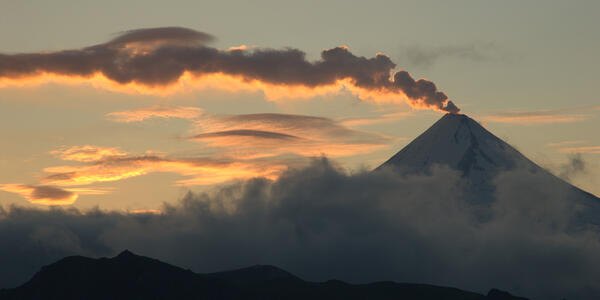
Architecture of a Layered Cone
Shishaldin's present cone grew on an older volcanic edifice that was substantially shaped by glacial erosion over geological time. The Alaska Volcano Observatory describes the younger cone as built on that glacially eroded predecessor, and several small satellite cones lie to the northwest of the main summit. Permanent snow and ice cover the upper reaches of the mountain through the Aleutian summer.
A plume of steam rising from the small summit crater is a persistent feature of the volcano. This fumarolic activity reflects that Shishaldin remains a thermally active system, distinct from the specific explosive events that have punctuated its history.
The 1999 Eruption and Remote Monitoring
On April 19, 1999, Shishaldin entered an explosive phase that produced a high ash column over the North Pacific. The opening pulse was short-lived, showing how quickly an Aleutian volcano can move from background restlessness to vigorous output.
Scientists tracked the sequence using seismic networks and satellite instruments, and the two approaches complemented each other in characterizing the eruption from a distance. Ground sensors provided real-time signal data while orbital imagery supplied a broader view of the ash plume, and the USGS subsequently cited the episode in retrospective assessments of Aleutian monitoring capabilities.
Position in the Aleutian Chain
Unimak Island sits at the northeastern end of the Aleutian arc, where a chain of active volcanoes extends westward across the North Pacific. Within that arc, Shishaldin holds the distinction of greatest height, though Alaska's overall altitude record belongs to peaks on the mainland far to the northeast.
Several neighboring volcanic centers share Unimak Island, compressing a range of eruptive landforms onto a single island mass. Shishaldin's steep symmetric cone distinguishes it visually from these neighbors, and its combination of height, persistent summit steam, and documented eruptive history has kept it a subject of observation by the Alaska Volcano Observatory.