
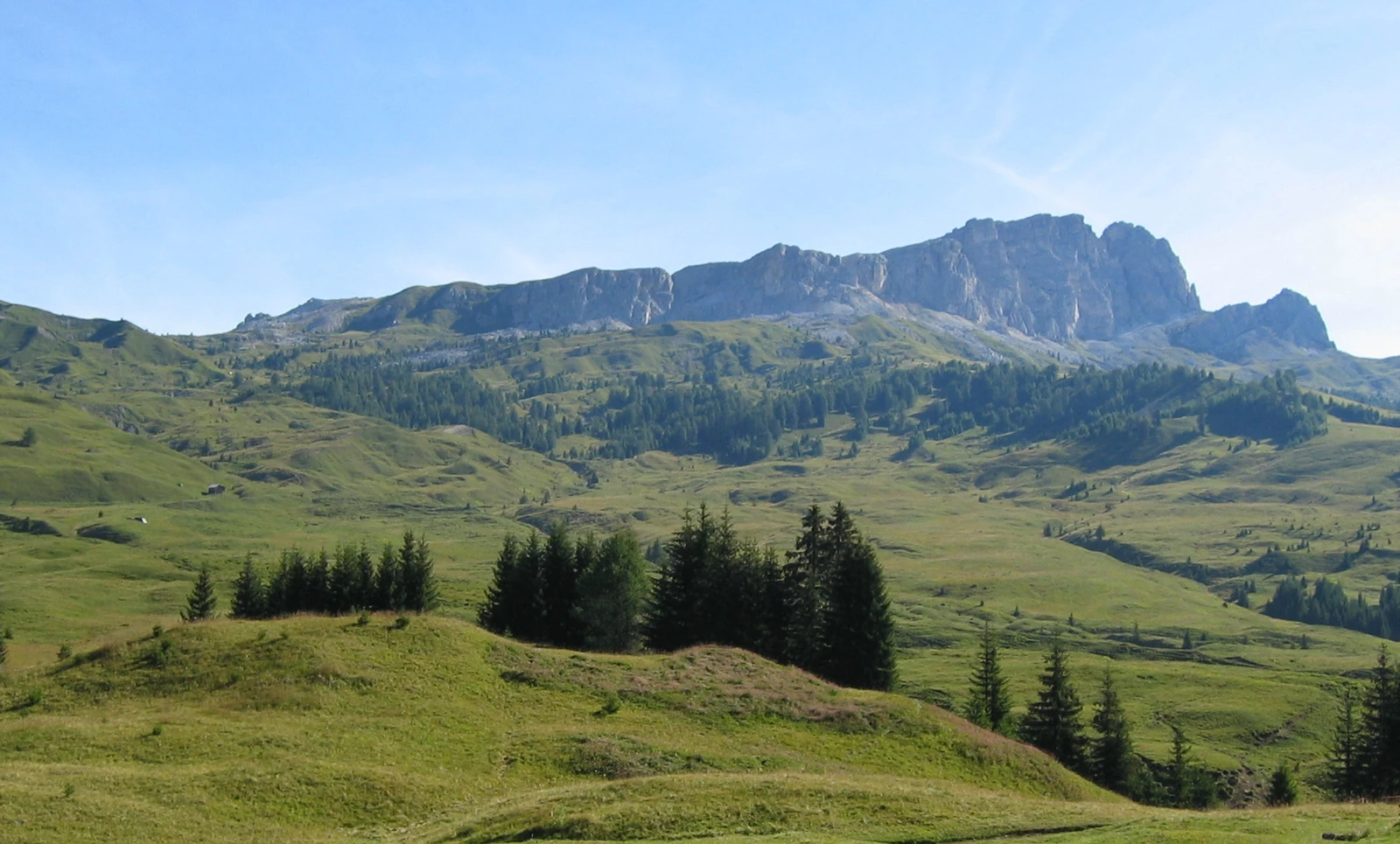
From Shallow Sea to Steep Rock
The ridge is composed of uplifted Upper Triassic carbonate sediments laid down during the Carnian stage. Studies published in Geo.Alp in 2011 and by Gian Luigi Trombetta for the Ferrara Natural History Museum in 2016 document two distinct episodes of carbonate growth at Piccolo Settsass, the smaller formation adjacent to the main ridge, interspersed with periods of deeper-water sedimentation. Coral and sponge patches preserved there record the character of that growth in a shallow-marine environment.
Along the main Settsass platform, stacked beds record successive carbonate build-up, while inclined flank deposits stepping outward preserve a record of the platform edge advancing into the adjacent basin. The tilted beds preserve the edge of a shallow-water platform where it once met deeper water.
Three Geologists and a Disputed Grain
In 1850, Bernhard Cotta described a pale, rounded-grained carbonate from Puders — an older name applied to the Settsass area — and speculated the grains might contain nummulites, single-celled organisms. Ferdinand von Richthofen, working in the region and publishing his geological description in 1860, examined the grains and identified them instead as ooids: particles built up through concentric mineral layers, an origin distinct from the shelled organisms Cotta had considered. In 1879, Eduard von Mojsisovics named the adjacent carbonate body the Richthofen Reef, honoring Richthofen's earlier regional work.
Georg Mutschlechner encountered the same type of rounded grains on the north side of the group during fieldwork in 1932 and published his comparison with the earlier accounts in 1935 through the Geological Survey of Austria. His observations confirmed Richthofen's ooid interpretation and connected his 1932 observations with a debate that had begun eight decades earlier.
Forte Tre Sassi and the Summer of 1915
At Valparola Pass, below the Settsass ridge, the Austro-Hungarian military constructed Forte Tre Sassi between 1897 and 1901 to defend the approach to Val Badia. On 5 July 1915, Italian 210 mm artillery struck the fort; the shells penetrated its unreinforced concrete roof and rendered it unusable, after which it was abandoned. The fort today houses the Museo della Grande Guerra.
Elsewhere along the same front, the Region of Veneto documents Austro-Hungarian Edelweiss trenches surviving between Sass de Stria and Montagna di Castello, in the corridor between Settsass and the broader Valparola position. The trenches trace the defensive positions that crossed this terrain during the First World War.
The Buttresses Seen from Cherz
A photograph taken from the Cherz meadows shows the Settsass ridge as a continuous rocky wall, its buttresses reading as a serrated profile against the sky. The Club Alpino Italiano’s circuit crosses below several of the same walls. From the meadow and from the foot of the rock, the view shifts from a single profile to a succession of buttresses.