
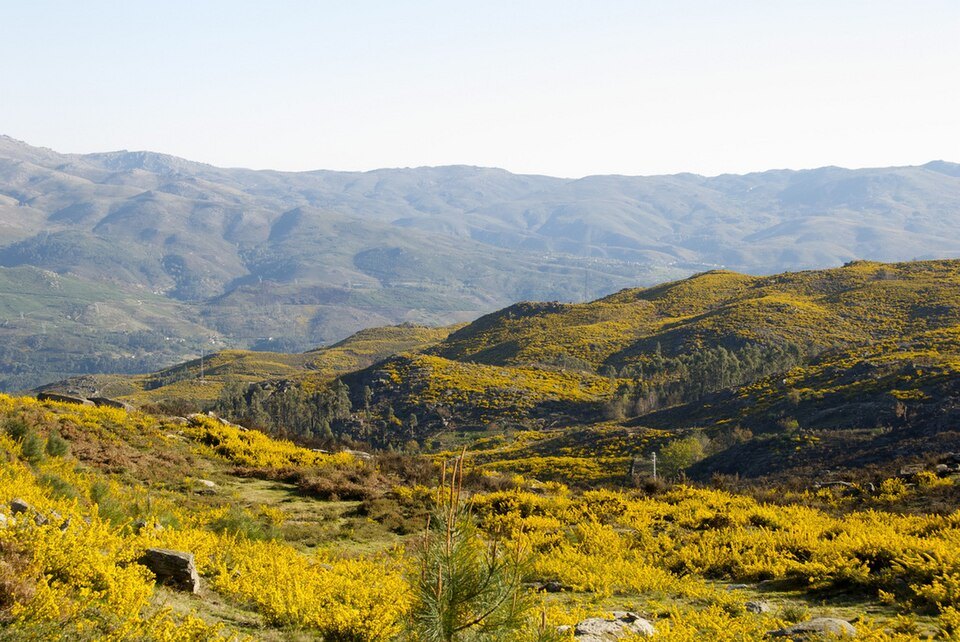
A Distinct Ridge within the Park
The Peneda-Gerês National Park brings together several mountain systems with their own characteristics, and the Serra Amarela represents one of these individualised units, clearly separate from the Serra do Gerês and the other ranges that make up the park. The ICNF describes the park's geographical structure as a set of ridges and valleys articulated within a landscape of great altitudinal range, where the high rocky areas contrast with the lower, more sheltered valley floors. The Serra Amarela fits into that pattern of alternation between elevated relief and depressions, occupying a position in the interior of the park that sets it apart from the better-known, more frequently visited edges.
Variscan Geology: Granites and Migmatites
The bedrock of the Serra Amarela is composed of heterogeneous syntectonic granites and migmatites, formations associated with the Variscan evolution that shaped the Iberian Peninsula more than 300 million years ago. The ICNF explicitly distinguishes the process by which these rocks were formed — which occurred at depth, under conditions of high pressure and temperature, during the Variscan orogeny — from the process of erosion that, over subsequent geological eras, gradually sculpted the present relief from that substrate. This distinction is fundamental for understanding the current morphology of the range: the rounded forms, the protruding outcrops and the granite blocks that punctuate the ridge are the result of a long history of exhumation and weathering of very ancient rocks, not of recent geological activity.
The Relationship between Ridge and Valleys
The vertical range between the top of the Serra Amarela and the valleys surrounding it within the Peneda-Gerês National Park is one of the elements that best conveys the geomorphological structure of this region. The ICNF describes the park's landscape as a system in which the high rocky ridges and the incised valleys constitute two worlds in permanent dialogue, with historically distinct climates, vegetation cover and forms of human occupation. The Serra Amarela participates in that dynamic as one of the most interior ridges of the park, where the granite relief is exposed with the greatest clarity before giving way to the slopes descending to the deeper valleys. This topographic relationship between high and low, between bare rock and the more temperate environments at lower elevations, largely defines the character of this range within the Peneda-Gerês as a whole.
Context within the Peneda-Gerês National Park
The Peneda-Gerês National Park, Portugal's only national park, encompasses a territory of great geological and morphological diversity, and the Serra Amarela represents one of its units least immediately associated with the park's best-known name. The ICNF documents on the geology and geomorphology of the park place the Serra Amarela within a wider system of granite and schist massifs, where different rock compositions and tectonic histories have produced reliefs with distinct characteristics. The altitude of around 1,360 metres places the Serra Amarela among the highest points in the park, although public attention tends to focus on other summits or on the Gerês valleys, leaving this ridge in a position of relative obscurity outside specialist circles in geology and physical geography.