
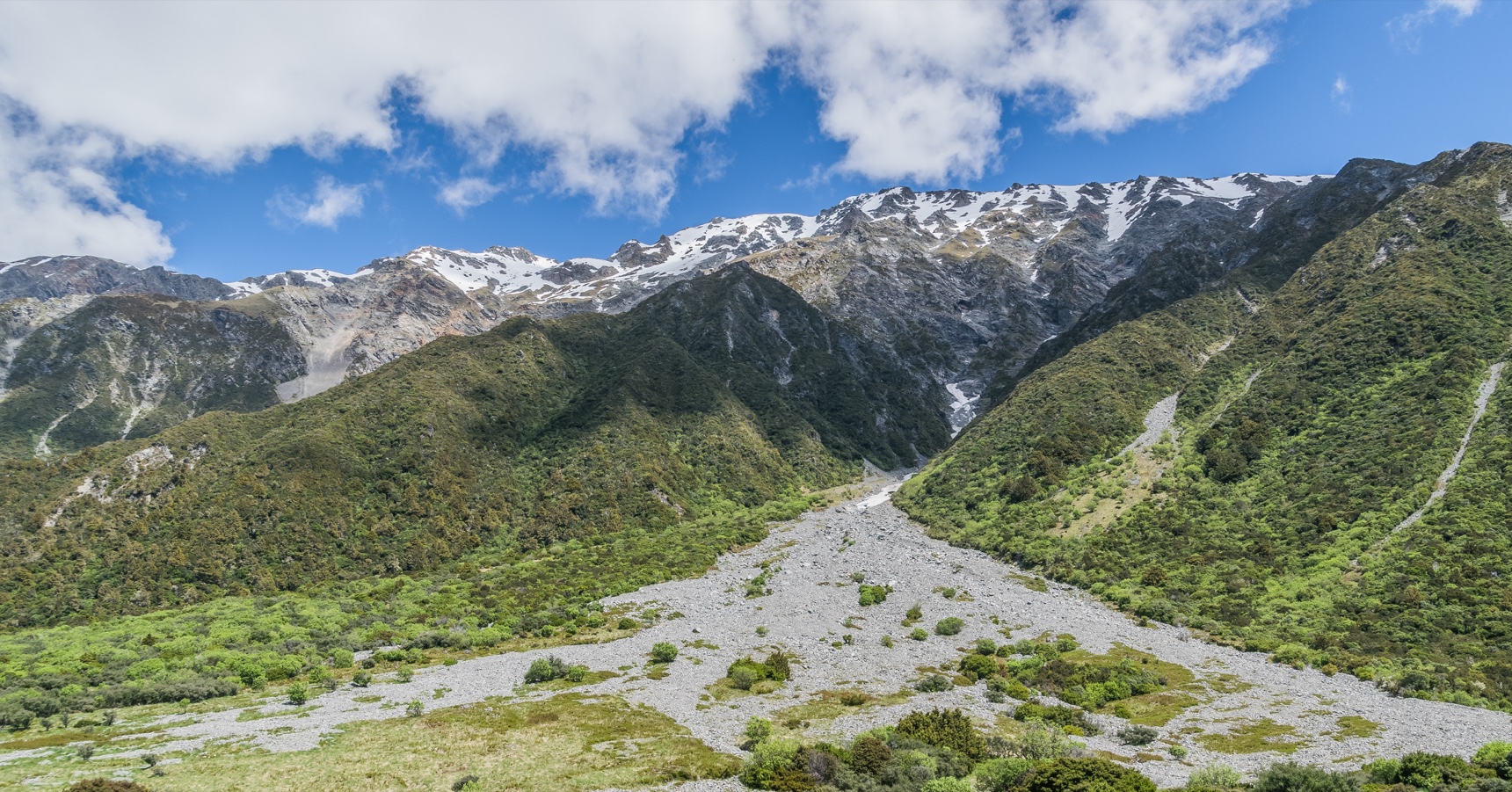
Folded Rock and Glacial Landforms
A. R. Lillie and B. M. Gunn, in their 1964 field mapping, documented steeply plunging folds in the range, with beds of hardened sandstone and finer siltstone interleaved through the structure. The 2003 Geoscience Society of New Zealand field guide noted that iron-rich minerals deposited by fluids moving through fault zones can stain exposed rock orange at certain points above the Hooker Valley.
Below these slopes, moraine ridges record where ice once deposited rock and sediment at the margins of the Hooker and Mueller glaciers. The folded rocks give a much older record of how the range took shape.
Exploration and Early Survey
George Edward Mannering’s 1891 account records that Edward Percy Sealy explored nearly the full length of the Mueller Glacier in 1867 and went as far up the Hooker Glacier as the junction with Empress Glacier in 1869. Mannering also described loose rock falling from the Sealy Range towards the Mueller Glacier.
The Department of Conservation dates the naming of Mueller Glacier to 1862, when Julius Haast named it for the botanist Ferdinand von Mueller.
The five Mueller huts
The first Mueller Hut was erected in 1914–15, as recorded in a 1915 parliamentary report. An avalanche destroyed its first replacement after just four months. The recovered timber was used for a temporary shelter.
The fifth Mueller Hut stands below Mount Ollivier, an early and formative climb for Edmund Hillary. He returned to open the hut in 2003.