
Location and position within the Alpstein
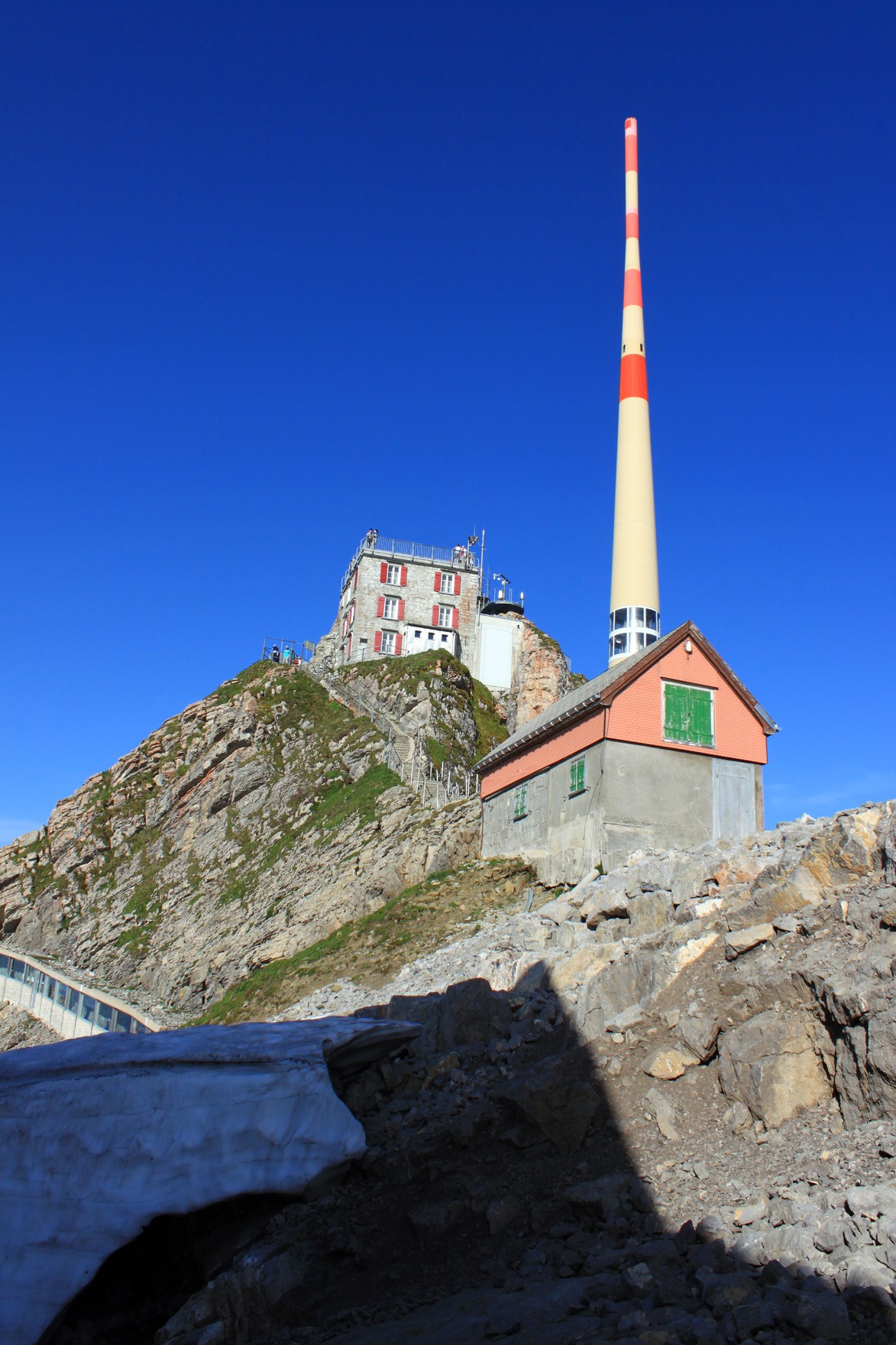
At 2,502 metres, the Säntis is the highest summit of the Alpstein. The massif rises prominently above the Mittelland and forms the dominant peak of the Appenzell region. The exposed position of the Säntis — rising freely without any sheltering subsidiary summits in the prevailing wind direction — is a fundamental condition for the weather patterns that have made the mountain a central point of Swiss climate observation over decades.
A measurement history in three phases
The climate record at the Säntis has a complex history of development, documented in detail by MeteoSwiss in the course of homogenising its climate series. The earliest values in the compiled series, covering the period 1864 to 1881, are not based on direct measurements at the Säntis itself: they were calculated from contemporaneous observations at the Pilatus and Rigi stations and converted to Säntis values. This fact is of considerable importance for the interpretation of early data.
Regular measurements at the Säntis began in 1882, though initially at a station situated at around 2,465 metres according to MeteoSwiss, and therefore still below the actual summit. Only in 1887 was the station relocated to the summit position. A third phase began in 1978 with the automation of the measurement equipment. This sequence of stages — converted third-party values, sub-summit measurements, summit measurements, automation — is essential for understanding the long Säntis climate series.
Orographic uplift and precipitation
The Säntisbahn explains the above-average precipitation at the Säntis by the orographic uplift effect that the Alpstein produces against moist air masses arriving from northwesterly and westerly directions. Moist air is forced to rise along the flanks of the massif, cools as it does so, and releases its moisture as precipitation — a mechanism that operates with particular intensity in this mountain setting.
Specific current extreme values or records cannot be stated on the basis of the available source material without precise temporal context. What is established is the assessment that the combination of altitude, north-facing slope, and orographic position places the Säntis among the most precipitation-rich mountains in the Swiss Alps.