
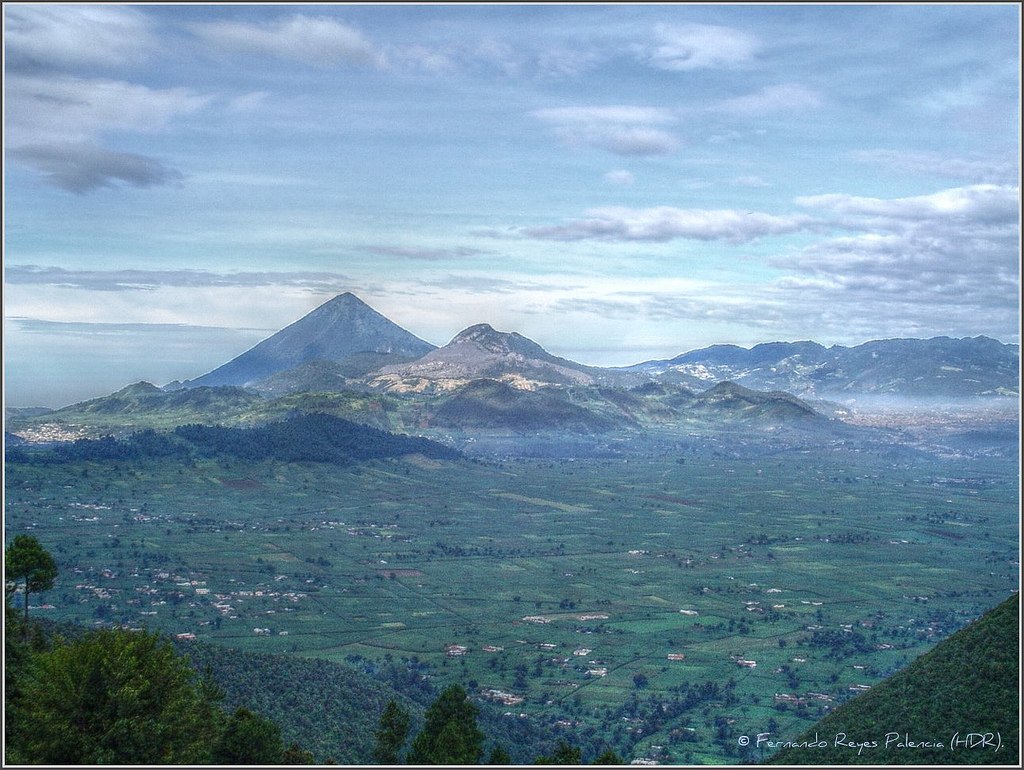
The 1902 eruption and the scar on the southwestern flank
The October 1902 eruption was Plinian in character, meaning it generated a column of volcanic material projected to great height along with the massive ejection of ash and rock fragments. The explosion opened a large crater in the southwestern flank of the original cone; that topographic scar is a geomorphological feature distinct from both the summit of the historic cone and the complex that would begin growing within it two decades later.
The birth and nature of Santiaguito
In June 1922, within the crater opened in the southwestern flank during the 1902 eruption, a lava dome began to grow. Over time that dome gave rise to the volcanic complex known as Santiaguito, situated on the southwestern flank and including the active vent called Caliente. The material building these domes is high-viscosity dacitic lava, whose accumulation and partial collapses produce hot flows of rock fragments, ash, and gas that descend the slopes.
Field studies recorded that in 1929 such flows traveled more than 10 km down the valleys south of the complex and reached villages and plantations in the region. When rainfall mobilizes volcanic deposits accumulated on the slopes into river channels, lahars form that also reshape the landscape and affect communities downstream.
Stratigraphy and long-term dynamics
The internal architecture of Santa María follows the classic stratovolcano pattern: successive layers of lava flows, ash deposits, and rocky material accumulated during eruptions prior to 1902. The 1902 crater interrupted that stratified sequence on the southwestern flank, exposed the succession of layers, and created the depression that now houses the Santiaguito complex, whose continued growth keeps modifying the mountain's silhouette as seen from Quetzaltenango and from localities such as Cantel.
Santiaguito in the context of active lava dome systems
Since its appearance in 1922, Santiaguito has been monitored by institutions such as the Smithsonian Global Volcanism Program and universities specializing in volcanology, which have documented recurring episodes of dome growth, ash emission, and pyroclastic flow generation. Decades of continuous observation of the complex have produced a detailed record of the mechanisms of construction and destruction of dacitic domes, information that volcanologists apply to the study of other volcanic systems along the Pacific Ring of Fire.