
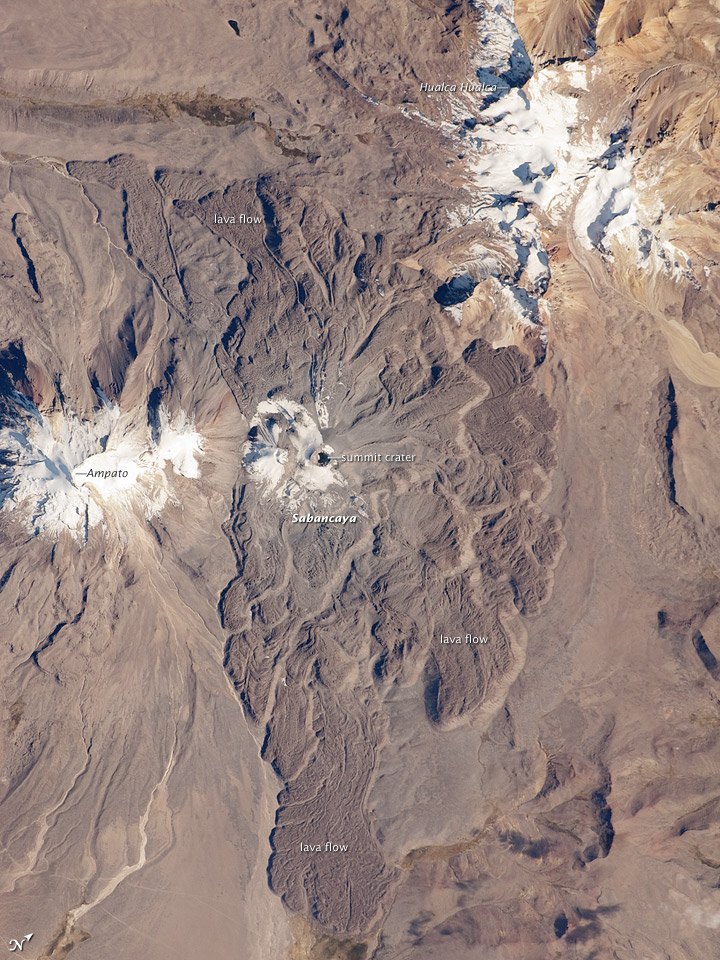
Morphology and geological setting
Sabancaya is a stratovolcano forming part of a volcanic complex together with Ampato and Hualca Hualca, arranged on the Arequipa altiplano close to the Colca canyon. IGP reports record the elevation of the volcanic edifice with slightly divergent values — 5,967 m and 5,976 m according to different measurements — without it being possible to fix a single definitive elevation.
Documented cycles of activity
The first well-documented modern eruptive cycle of Sabancaya spans the period from 1990 to 1998. The antecedents of that episode go back to the 1980s, when fumarolic emissions and seismic activity in the complex intensified. In response to that development, the IGP installed temporary stations on the volcano in April 1990, establishing the instrumental basis that made it possible to record the cycle.
In 2013 the IGP recorded a new increase in seismicity and fumarolic emissions at Sabancaya and set up a new telemetric monitoring network. The IGP report covering the period May 2022 to July 2023 dates the start of the most recent explosive cycle to 6 November 2016. The available documents do not attribute an end date to that cycle.
The methodological value of continuous monitoring
The instrumental history of Sabancaya shows how knowledge of an active volcano is built up incrementally. Each monitoring network installed by the IGP — the temporary network of 1990 and the telemetric network of 2013 — expanded the resolution with which activity cycles can be characterised.
The study of these cycles makes it possible to explain how to separate periods of seismicity, degassing and eruption in the record of a stratovolcano integrated within a larger volcanic complex.