
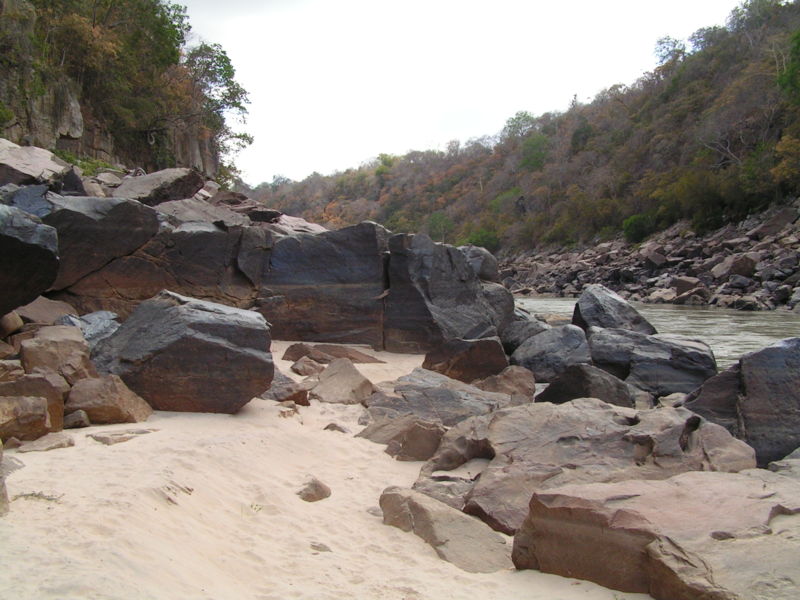
Gorge, River, and Surrounding Terrain
The photograph shows the gorge before dam construction. Downstream near Beho Beho, a Sentinel-2 image from 28 June 2026 shows sandbars breaking up the channel between wooded slopes.
The geology of the reserve spans Karoo sandstone formations and older metamorphic basement rocks distributed across the broader landscape. The UNEP-WCMC datasheet records the relief, geology, and hydrology of the Rufiji corridor as integrated features of the Selous system, with the river functioning as the primary drainage axis for a large portion of southern Tanzania.
Survey History and the Name Stiegler
The gorge carries the name of Franz Stiegler, who measured the Rufiji under German colonial rule to assess its navigability. Using archival records, historian Emma Minja traced Stiegler’s arrival at the rapids to July 1907. He died in 1908 during the survey period, near Mberera Mountain, well upstream. After independence, Tanzania studied the river’s hydropower potential in the 1960s and 1970s.
UNESCO Inscription and the Danger Listing
UNESCO inscribed the Selous Game Reserve as a World Heritage property in 1982, recognising its landscape and biodiversity values. In 2014 the World Heritage Committee placed the site on the List of World Heritage in Danger following a documented poaching crisis that threatened wildlife populations across the reserve. The inscription covers the broader Selous landscape, of which the Rufiji hills and gorge form a central geographic component.
Julius Nyerere Hydropower Project
Construction of a dam at Stiegler's Gorge proceeded as the Julius Nyerere Hydropower Project. The UNESCO World Heritage Committee's 2025 decision records that all nine turbines of the project became operational in April 2025. The Tanzanian government announced the formal inauguration of the power station on 22 August 2026 and publicises an installed capacity of 2,115 MW.
Tanzania’s government presented the project as an investment in national electricity generation. The World Heritage Committee, in its 2025 decision, expressed concern about lasting damage to the natural features for which the property was listed.