
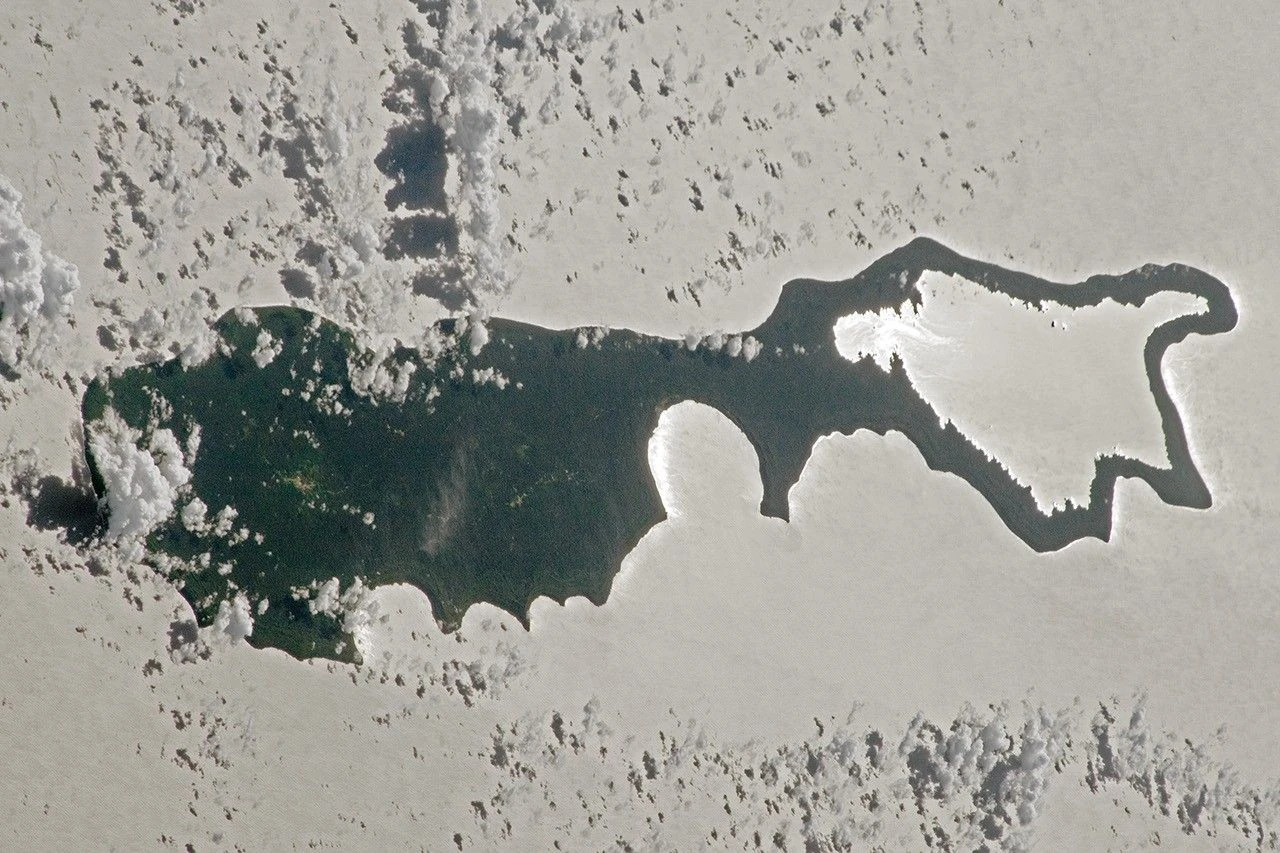
A Reef Complex Raised from the Sea
In a 1973 study, geologist Geoffrey R. Taylor described how reefs grew in stages on a subsiding platform. The older reef rock was transformed into a rock rich in the mineral dolomite. As the reef complex rose, younger fringing limestone formed along its margins and sediment accumulated inside the enclosed lagoon.
Lake Te Nggano and the Enclosed Basin
The brackish lake covers about 155 square kilometres. UNESCO also calls it Tegano. In the photograph taken from the International Space Station on 8 January 2023, sunlight reflected from the lake and sea makes the forested rim stand out. The glare is especially bright where the water was smooth.
East Rennell as World Heritage
UNESCO inscribed East Rennell as a natural World Heritage site in 1998. The boundary includes the lake and the surrounding forests in the eastern part of the island. The nomination records customary land and marine tenure, including rules that local communities use to manage fishing.
In 2019 the World Heritage Committee reported a logging concession that extended to within 200 metres of the protected area. It asked for an environmental impact assessment and work to understand how the habitats of eastern and western Rennell are connected.