
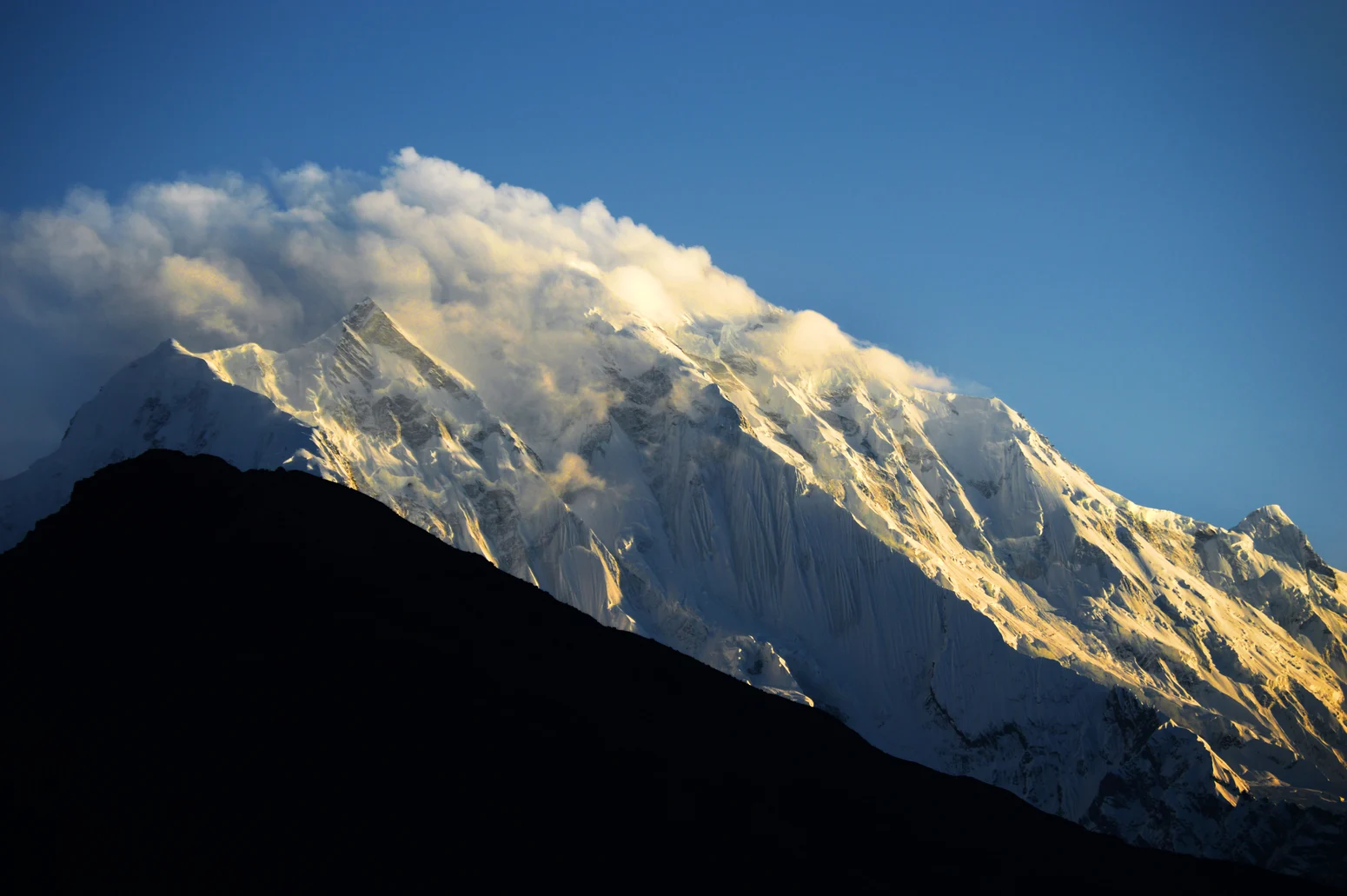
The 1958 First Ascent and the Role of Hunza Porters
Exactly six expeditions had attempted Rakaposhi before the British–Pakistani Forces Himalayan Expedition placed two climbers on the summit. On 25 June 1958, Mike Banks and Tom Patey reached the top via the southwest ridge, departing in a blizzard from their highest camp. The route required the establishment of six camps, and the team climbed without supplemental oxygen throughout. A steep snow feature known as the Monk's Head marked a critical point on the lower ridge, and Hunza porters carried expedition supplies beyond it, a contribution that formed part of the logistical foundation the summit pair relied upon.
Banks and Patey's success came despite deteriorating weather throughout the climb, with snowstorms and avalanches hindering camp establishment and the final push. Their account, recorded in the American Alpine Journal, describes a five-hour effort from the top camp to the summit in blizzard conditions, with Banks sustaining frostbite to his feet and Patey to his hand.
The Northwest Ridge and a Widening Route Map
In 1979 a Polish-Pakistani team completed an ascent via the northwest ridge, a line that had been the subject of earlier reconnaissance before that expedition committed to a full attempt. The AAJ report on that climb noted the groundwork laid by prior ridge studies, suggesting that the northwest ridge demanded its own sustained campaign before it yielded a successful line. This ascent broadened the known geography of Rakaposhi's upper mountain and demonstrated that the southwest ridge, though the route of the first ascent, was not the only viable path to the summit.
Alpine Style on the Southwest Ridge
In 2021, French alpinists Hélias Millerioux and Patrick Wagnon returned to the southwest ridge under a fundamentally different set of constraints. The American Alpine Journal describes their effort as the first known alpine-style ascent of that route: a four-day round trip from base camp, moving without fixed camps or supplemental support. The pair's own account after the climb drew attention to the physiological challenge of slow altitude loss on the descent and to the character of the ridge itself—a long, sharp arête that demanded sustained technical attention on the way down as much as on the way up.
The contrast between the 1958 expedition and the 2021 climb is not one of difficulty overcome but of philosophy applied. Banks and Patey built a ladder of six camps and relied on a team of porters active well above base camp; Millerioux and Wagnon compressed the entire ascent and descent into four days on the same terrain. Both efforts engaged the same southwest ridge at the same altitude, making Rakaposhi an unusually clear case study in how expedition style has shifted across six decades of high-altitude mountaineering in the Karakoram.
Geography and Identity
Rakaposhi's position in the Karakoram at 7,788 metres places it among the range's most prominent peaks, and its southwest ridge—a long, sharp feature that has now been climbed in both expedition and alpine style—is the defining landform of its climbing history. The nearby summit of Diran at 7,257 metres is a separate mountain and should not be conflated with Rakaposhi's ridgelines or ascent records. The Monk's Head, the named snow feature on the lower southwest ridge, marks one of the route's historically significant technical passages and appears in the earliest accounts of the mountain's exploration.