
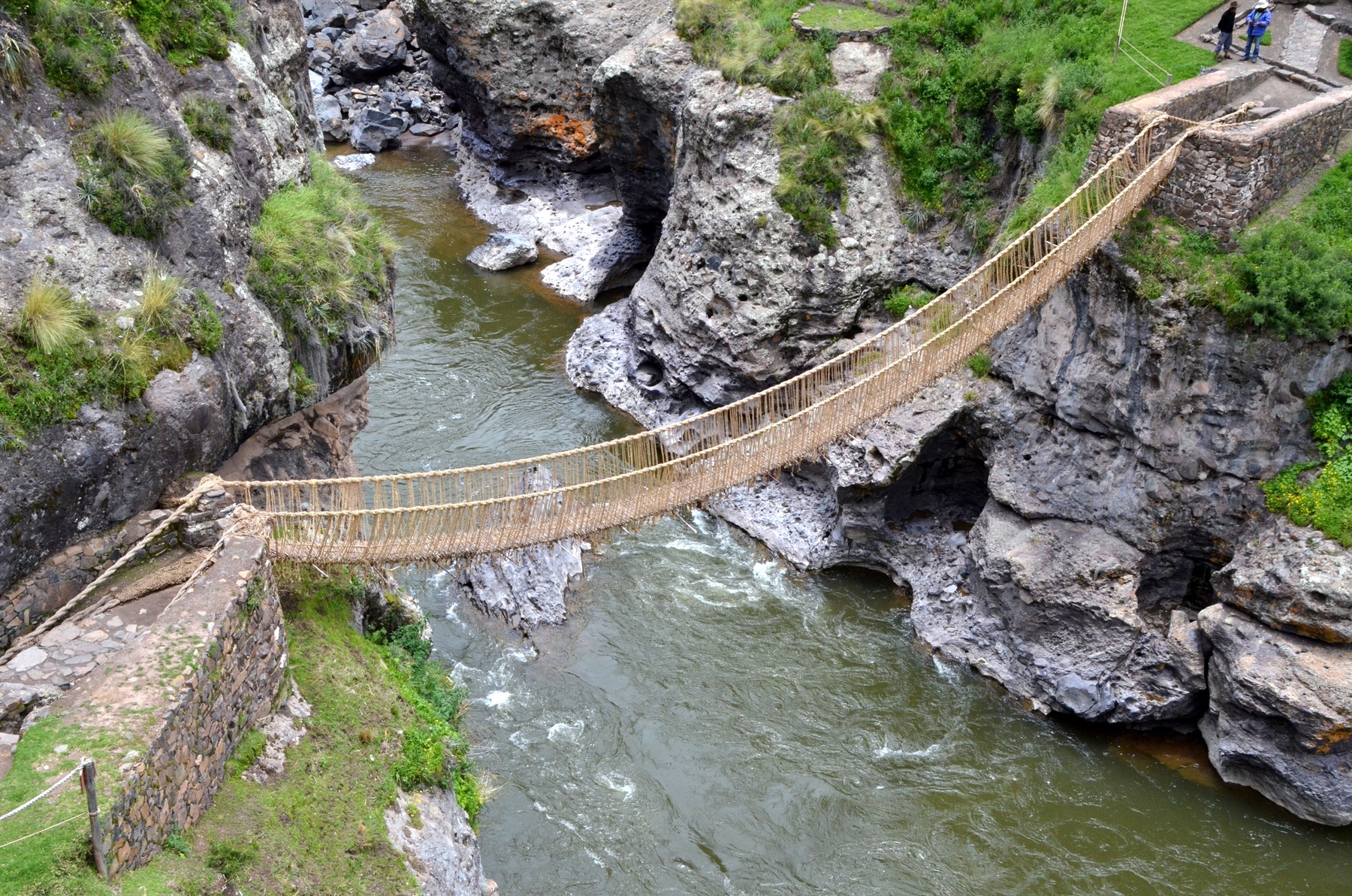
The gorge and the bridge structure
At the narrowest point of the gorge, stone abutments anchor the cables on both sides of the river. The Mincetur tourism inventory, record 935, registers a length of 28 metres for the bridge. The February 2018 photograph shows the complete structure between the abutments and the gorge channel.
The crossing formed part of the Contisuyu road, a branch of the Andean road system known as the Qhapaq Ñan. In 2025, the Dirección Desconcentrada de Cultura de Cusco ordered provisional protection of the archaeological landscape surrounding the bridge.
Weaving technique and materials
Ethnographic research by the Ministry of Culture documents that families prepare cords from the fiber of a high-Andean grass called q'oya or qoya ichu. These thin cords, known as q'eswas, are braided to form thicker ropes. Four of these thicker ropes support the deck and two form the handrails. All six are tensioned and secured to the stone abutments.
Two master bridge builders, called chakaruwaq, work from opposite ends of the gorge and meet in the center upon completing the weaving. The process unfolds over three consecutive working days, followed by a celebration at the conclusion of construction.
Communities and intangible heritage
The annual renewal is a communal undertaking involving four Quechua-speaking communities, Huinchiri, Chaupibanda, Choccayhua, and Ccollana Quehue. Knowledge and techniques are transmitted within families, and the celebration includes offerings to Pachamama and the apus. In 2013, UNESCO inscribed the knowledge, techniques, and rituals of the annual renewal of Q’eswachaka on the Representative List of the Intangible Cultural Heritage of Humanity.