
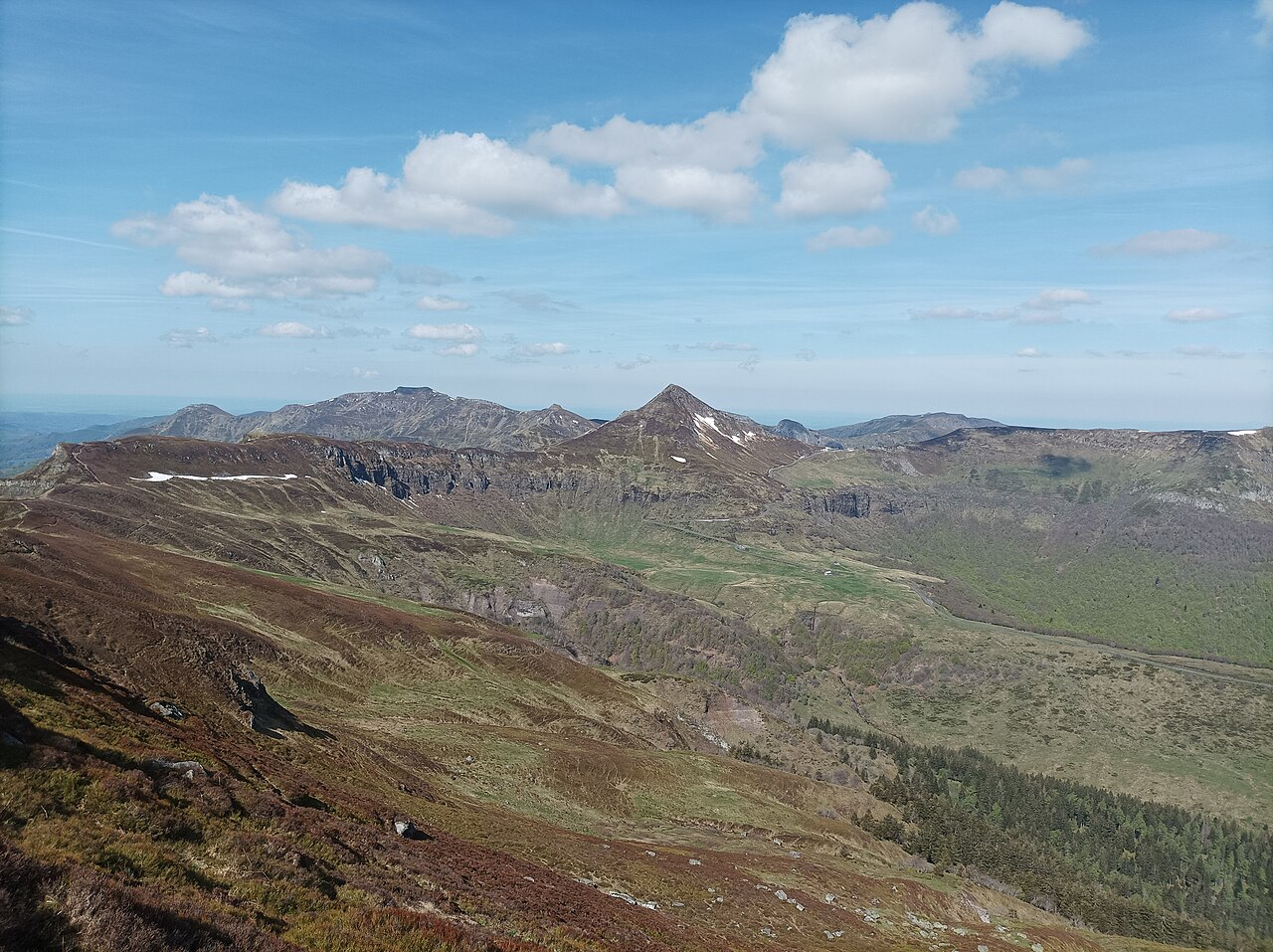
A stratovolcano sculpted by glaciers
The Puy Mary belongs to a single volcanic Cantal edifice, a stratovolcano whose several summits punctuate the ridges. It is not an isolated volcano but a fragment of a vast ensemble whose silhouette was profoundly reworked by the Quaternary glaciers. Glacial valleys radiate from the central zone, cutting corridors that exposed the constituent materials of the edifice: volcanic breccias and rocks associated with the ancient lavas, as described by the Parc naturel régional des Volcans d'Auvergne.
This combined work of volcanism and glaciation produced a relief of sharpened ridges and deeply incised valley heads that characterises the Monts du Cantal today. The summer pasture plateaux and the broad grassy surfaces capping certain heights bear witness, for their part, to a long pastoral occupation that has been superimposed on these inherited landforms.
The Grand Site de France: recognition of the Cantal landscape
Since 2012, the massif has carried the label Grand Site de France Puy-Mary Volcan du Cantal, a distinction that highlights both the exceptional quality of the landscape and the efforts made in its management. The Parc naturel régional associates with this recognition the ridges, glacial landforms and summer pasture plateaux that compose the visual identity of the place.
This designation concerns not only the shape of the terrain but also its cultural dimension: the estives, those high-altitude grazing grounds, are inseparable from any reading of the Cantal landscape. They bear witness to a long-standing relationship between rural communities and the heights of the massif, of which the Puy Mary is the most immediately identifiable symbol.
Geographic reference points
At 1,783 m, the Puy Mary stands below the Plomb du Cantal (1,855 m), the highest point of the massif. This difference in altitude places the Puy Mary within a group of summits rather than as an isolated peak. The valleys descending from the central zone towards the foothills form the natural axes of access into this massif, whose radiating geography from the volcanic core remains legible in the course of its rivers.