
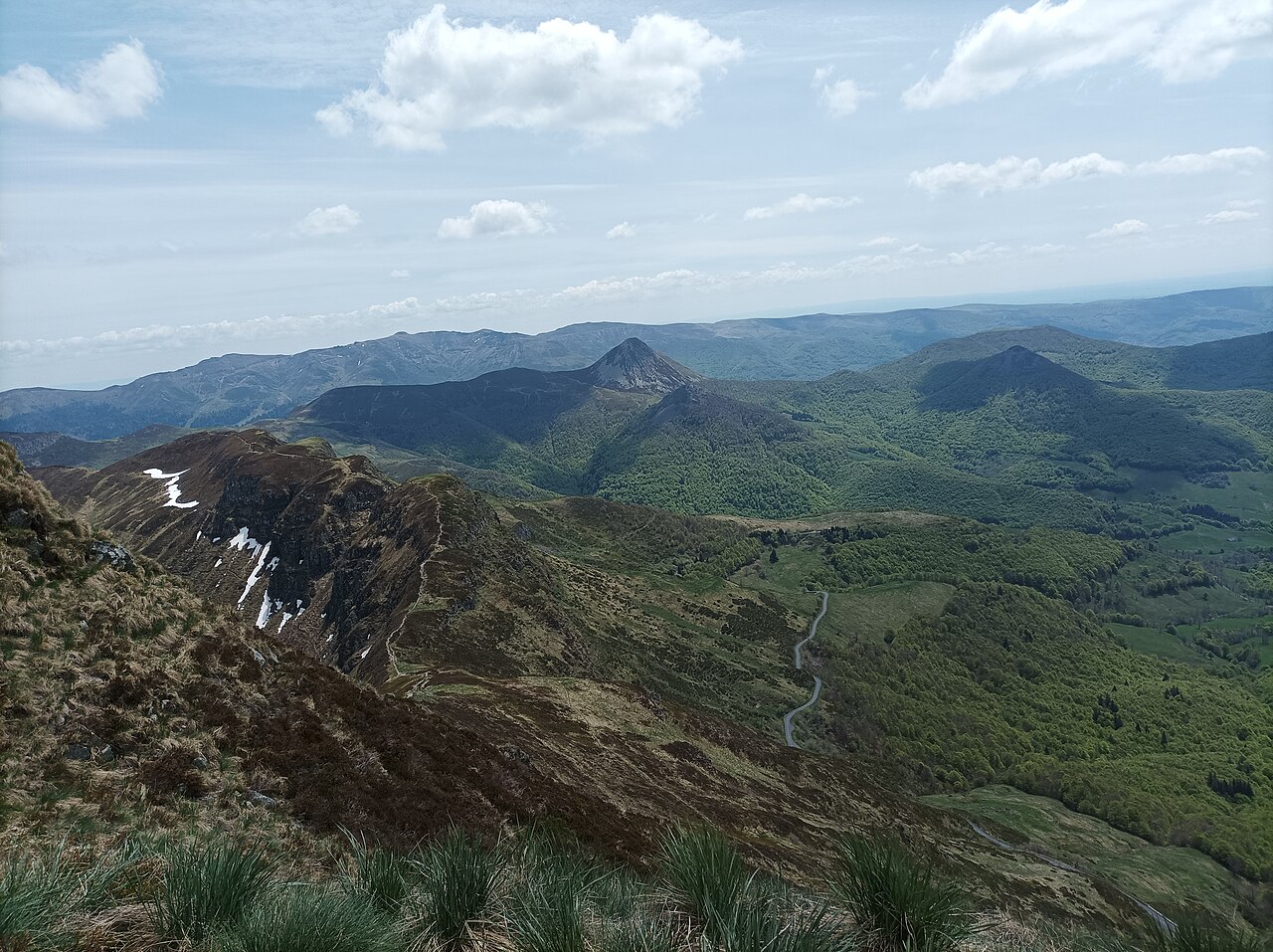
An origin in the Cantal phonolites
The rocks that make up the Puy Griou belong to the phonolites, a viscous lava associated with the later phases of Cantalian volcanic activity. The field notebook of the Parc naturel régional des Volcans d'Auvergne describes the Griou as a residual volcanic feature — a dome or plug brought into relief by erosion — rather than as a volcano in its own right. Accumulations of phonolitic debris have slid down its flanks, forming a characteristic apron of blocks at the foot of the cone.
This origin determines the Griou's particular morphology: its visual isolation in the landscape is the product of differential resistance to erosion, the phonolites having withstood the glacial and periglacial dismantling that shaped the Cantal during the Quaternary better than the surrounding materials.
The imprint of the glaciers
Glacial erosion played a determining role in the individuation of the Puy Griou. The Quaternary ice sheets carved the valleys and cirques around the Cantalian massif, progressively isolating the most resistant relief features. It is this process that gives the Griou its form as a free-standing cone, recognisable from the surrounding ridges, and that distinguishes its silhouette from that of the more massive domes in the neighbourhood.
The Griou within the Monts du Cantal complex
The Puy Griou forms part of a larger ensemble designated under the Natura 2000 framework as Monts et Plomb du Cantal, which groups together ridges, summits, upper slopes and valley heads. The highest point of this complex, at 1,855 metres, is the Plomb du Cantal, not the Griou. Publications of the Parc naturel régional avoid assigning a precise elevation to the Griou alone without confirmation from surveys specific to this summit, as several summits of the Cantal collectively exceed the 1,600-metre threshold.
This membership of a large-scale complex invites consideration of the Puy Griou not as an isolated feature but as a landmark within an overall volcanic topography, where the logic of ridges, valleys and summits is articulated according to a shared geological history — that of the largest stratovolcano in Europe by its surface footprint.