
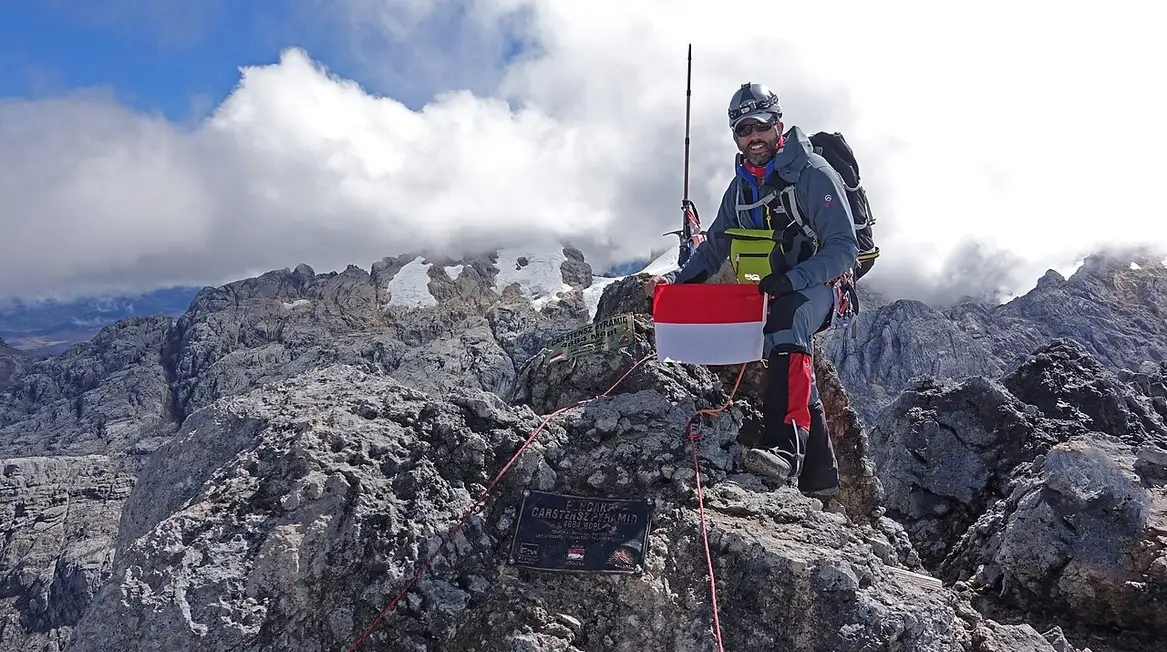
A Peak With Two Names
The mountain is known by two names rooted in different eras of engagement with the region. The name Carstensz Pyramid derives from Jan Carstensz, a Dutch mariner who in 1623 reported sighting ice near the equator. The Indonesian name Puncak Jaya is also widely used. Both names refer to the same main rock summit at 4,884 metres, an elevation established by trigonometric survey and cited in the Journal of Glaciology.
The Sudirman Range itself sits in the central highlands of New Guinea, a landscape whose extreme isolation shaped both the pace and character of outside exploration. Early twentieth-century expeditions reached the broader massif and documented its glaciation through photography and mapping well before satellite observation became possible. The 1936 expedition, for instance, reached neighbouring summits Carstensz Timur and Ngga Pulu, but the main Puncak Jaya summit was not achieved on that attempt.
The 1962 First Ascent
The first confirmed ascent of the main rock summit took place on 13 February 1962, when Heinrich Harrer, Philip Temple, Russell Kippax, and Albertus Huizenga reached the top together. The Alpine Journal carried an account of the Carstensz Pyramid ascent, and Guinness World Records recognises the climb as the first ascent of Puncak Jaya. The route required navigating the peak's characteristically steep limestone faces, which present a technical challenge that set this summit apart from many of comparable altitude elsewhere in the world.
The years between Carstensz's 1623 ice sighting and the 1962 ascent represent an unusually long interval between first European documentation and first summit, a span that reflects both the logistical difficulty of reaching the interior of New Guinea and the political complexity that surrounded access to the region through much of the twentieth century. That gap has made the mountain's climbing history a subject of sustained interest in alpinist literature.
Glacier Retreat Across the Mountain Group
A 2025 study by Ibel, Mölg, and Sommer published in The Cryosphere examined glaciation across the Puncak Jaya mountain group, working from digitised historical maps and 2023–2024 satellite imagery. The researchers estimated that total glaciated area across the group declined from approximately 19.3 km² around 1850 to 6.4 km² in 1974, and further to 0.165 ± 0.008 km² by 2024. The study attributes the continuing pattern to ongoing tropical glacier recession and projects that remaining glaciated area could disappear around 2030 under continued recession. Remaining glaciated features include parts of the East Northwall Firn and Carstensz Glacier, which lie within the mountain group rather than on the exact summit itself.
The study notes that if current retreat rates persist, disappearance of the remaining glaciers could occur around 2030 — a conditional projection rather than a confirmed outcome. The long-term record assembled by Ibel and colleagues draws on sources stretching back through the era of photographic and cartographic expeditions, establishing that significant contraction predates the satellite age by decades. For a mountain sitting almost precisely on the equator, Puncak Jaya's tropical glaciers have drawn scientific attention as indicators of climate patterns in one of the least-studied high-altitude environments on the planet.
Landform and Setting
Puncak Jaya's profile is defined by its limestone construction, a material that produces the sharp ridges, sheer faces, and karst features characteristic of the Sudirman Range's higher terrain. The pyramid shape that gave rise to the Carstensz name is most legible from certain approach angles, where the summit block rises with unusual geometric clarity above the surrounding ridgelines. The surrounding landscape of the central New Guinea highlands is one of the most biologically and culturally distinct regions in the world, though the mountain itself sits at an elevation far above the forest zones that characterise the broader region.
The combination of equatorial location, extreme elevation, and persistent — if now diminished — glaciation makes the Sudirman Range's highest point a site of ongoing scientific relevance. The convergence of a contested naming history, a late first ascent, and an unusually well-documented glacier recession gives Puncak Jaya a layered significance that few summits of comparable height can match.