
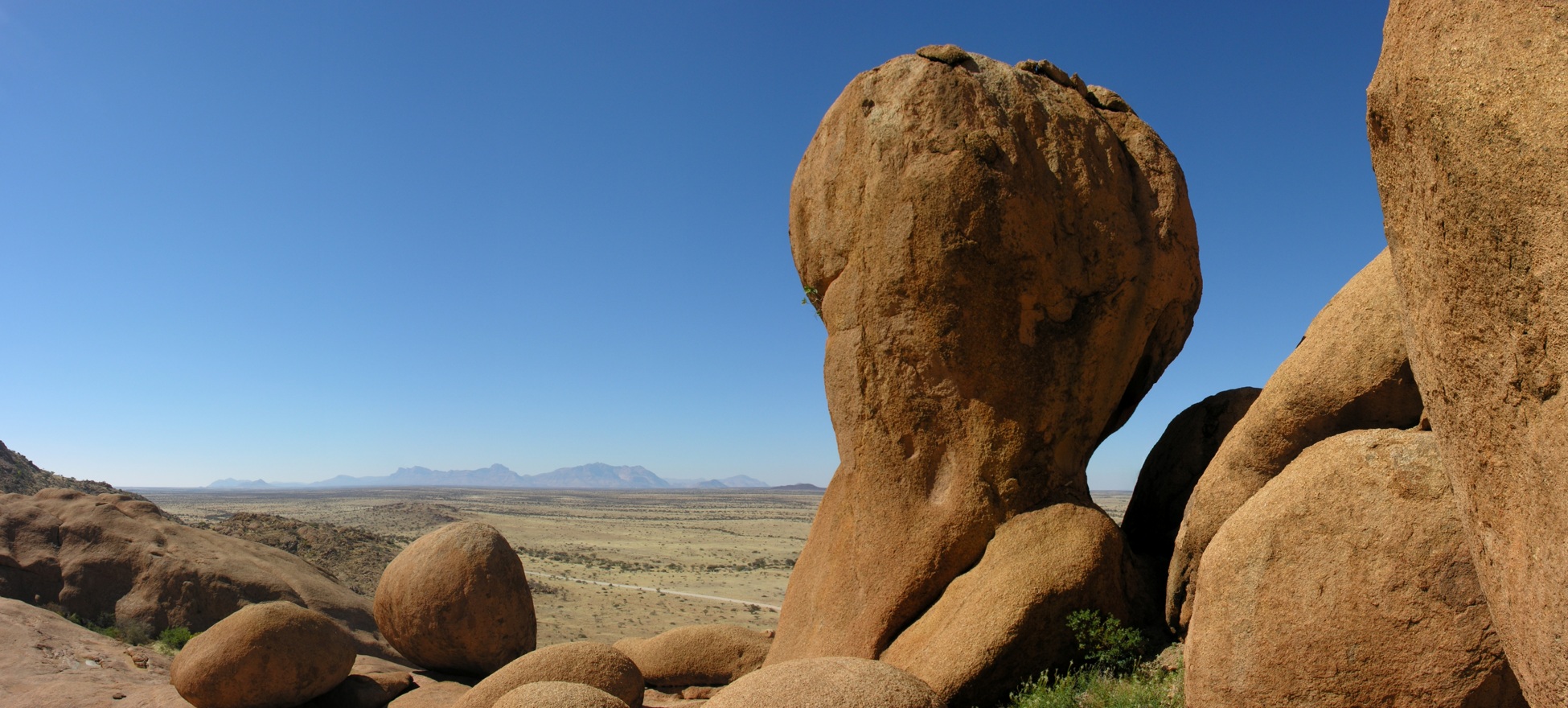
Granite Origins and Boulder Morphology
The granite of the Pontok Mountains intruded into older Damara metamorphic rocks approximately 135 million years ago, beneath younger Karoo sediments that already covered the area. The Geological Survey of Namibia places this intrusive event in the context of the breakup of Gondwana and the opening of the South Atlantic Ocean. As the overlying country rocks eroded over geological time, the granite was progressively exposed, emerging as isolated domes above the surrounding plain in the pattern characteristic of the wider Spitzkoppe area.
Weathering along joint planes gradually rounded the exposed granite masses into the boulder forms visible today at the rock shelter locality near the eastern end of the range. Dark ridges nearby mark volcanic dykes that formed before the main granite intrusion.
Proclamation and Early Investigation of the Rock Shelter
A rock shelter at the eastern end of the Pontok Mountains, located in the wider Spitzkoppe archaeological area, holds a substantial body of San paintings. The site carries the documentary title Bushman Paradise in heritage records held by the Namibia National Archives. Geologist Reuning excavated the site in 1917, and Henri Breuil studied it in 1948 and published his account in 1955. The shelter was formally listed as a protected heritage site on 1 July 1954 under Government Notice 159 in Government Gazette 1844.
A regional survey by Kinahan in 1990 catalogued 37 rock-art and archaeological sites across the broader area; an earlier count attributed to him recorded more than 200 individual paintings within the shelter itself.
The 2016 University of Namibia Conservation Survey
A study published in 2016 by Goodman Gwasira and G. Katjiuongua of the University of Namibia applied a systematic method to document the condition of the shelter's paintings. The team measured the shelter at 45 metres in length and divided it into nine sectors of five metres each, photographing and recording each sector in sequence to allow direct comparison of damage across the full extent of the shelter wall.
The survey recorded figures painted in red, and some giraffes rendered in both red and white. The team identified human-caused damage as significant among the factors affecting preservation, alongside natural weathering processes.