
An island built in stages
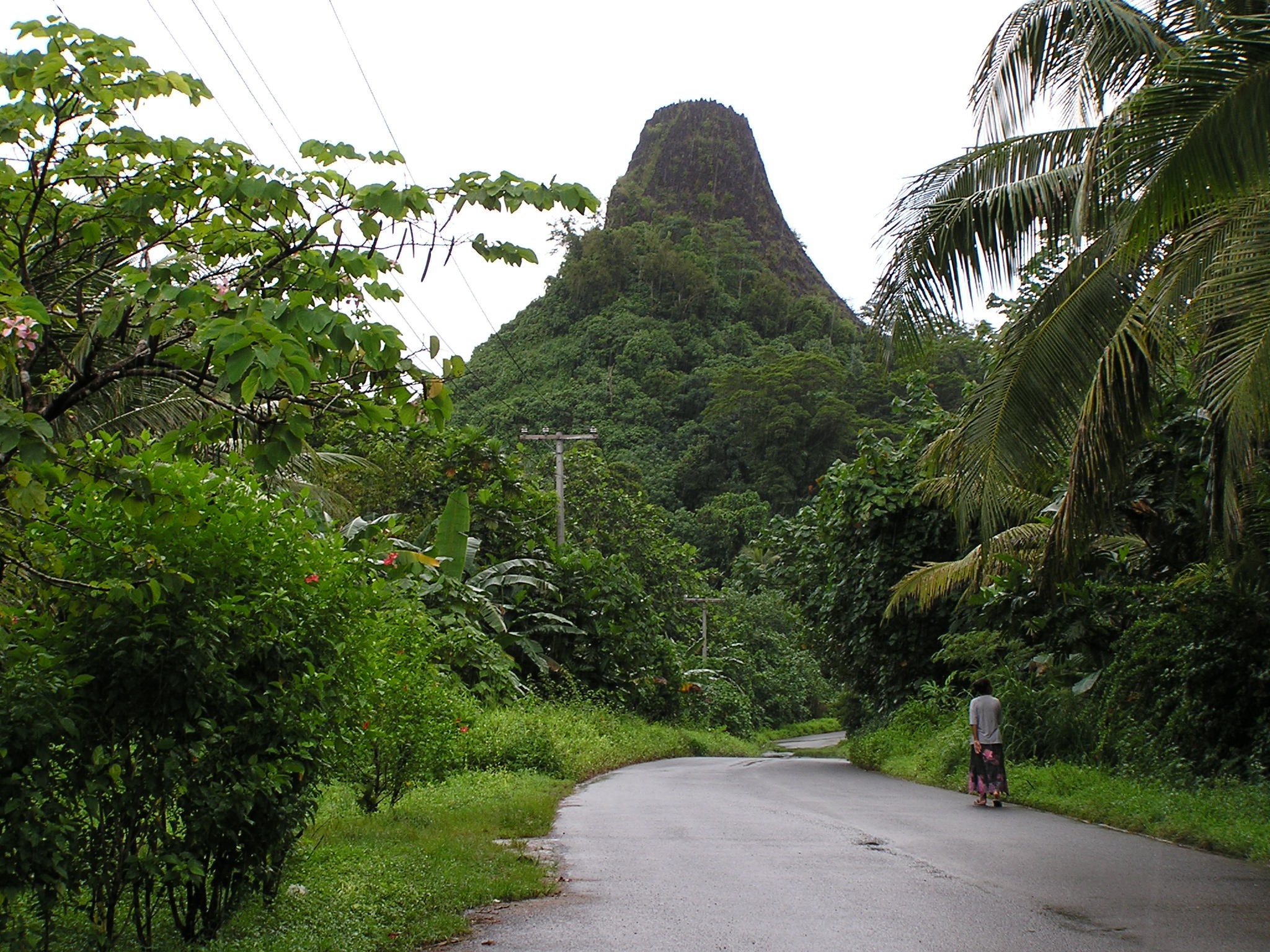
Geologic field mapping and geochemical analysis by Spengler, Spencer, Mahoney, and Goles documented three distinct lava series on Pohnpei. Repeated lava flows built the main shield about 8.5 to 7.5 million years ago. A younger Awak series, deposited approximately 7 to 3 million years ago, left deposits and features such as Pwisehn Malek, a volcanic plug formed where magma solidified inside a volcanic opening and was later exposed as surrounding rock eroded away. The youngest of the three lava series, Kupwuriso, dates to roughly 2 to 1 million years ago. Rivers cut steep valleys into the volcanic rocks. Offshore, a barrier reef nearly encloses the lagoon.
A stream caught between two eruptions
On Lenger, a small volcanic island sitting within Pohnpei's lagoon, a U.S. Geological Survey study by Anthony and Spengler found rounded stones carried by a stream between two lava layers. The upper flow cooled into columns. The gravel shows that a stream had time to form and move stones over the older volcanic surface before another flow buried its bed.
Volcanic stone at Nan Madol
When lava cools and contracts, it can fracture into long, regular columns. X-ray geochemical analysis by McCoy and colleagues in 2016 linked some basalt columns at Nan Madol, an ancient center on artificial islets off eastern Pohnpei, to Pwisehn Malek on the opposite side of the island. The team identified stone from that source in the main tomb enclosure on Nandauwas islet. Dating coral incorporated into the tomb put the beginning of monumental construction there at about 1180–1200 CE.