
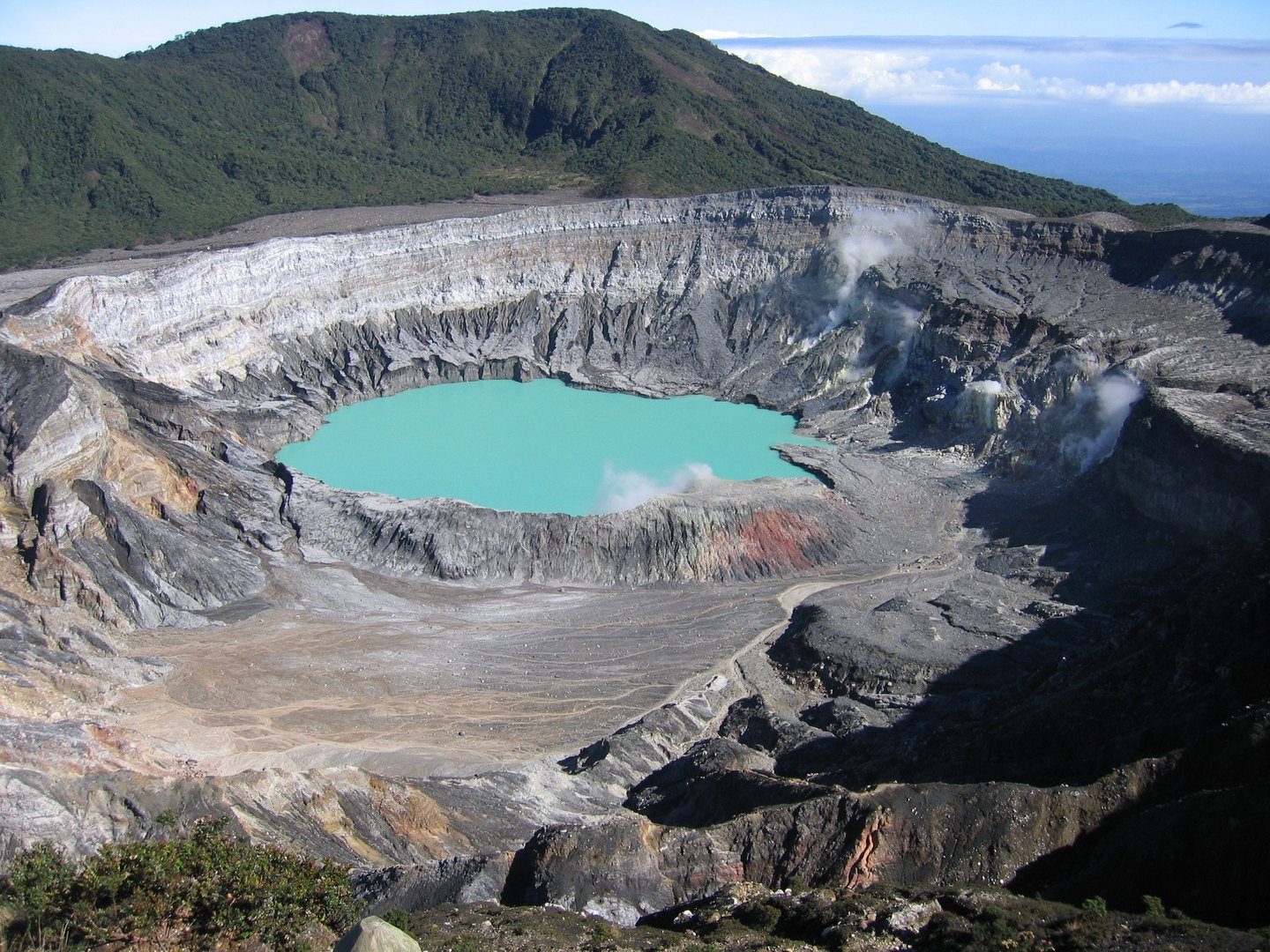
Two lakes, two geochemical worlds
Laguna Caliente occupies the active main crater of Poás and exhibits extreme acidity by the standards of volcanic lakes worldwide. Historical samples taken between 2014 and 2016 recorded pH values between 0.28 and 0.4, a direct result of intense volcanic degassing and geothermal heat input that continuously alter the water chemistry. Sulfur deposits and lake sediments testify to prolonged cycles of activity in this crater lake.
Laguna Botos occupies a crater separate from the main one and presents very different conditions: fed primarily by rainfall, its cold water has earned it the alternative name Laguna Fría. This duality within a single volcanic edifice reflects how tectonic faults delimit a sunken area at the summit, conditioning the overall arrangement of the structures it contains.
Geological foundation and dome cycles
The deep architecture of Poás corresponds to an ancient stratovolcano built up by successive layers of lavas and pyroclastic products; atop that base lie explosive materials attributed to both Poás and neighboring Barva. This stratified substrate clearly records cycles of activity: between 1953 and 1955 the hot lake dried up completely and a lava dome grew inside the crater; in 1965 the lake re-formed, once again filling the cavity.
The dome that emerged during that cycle persisted for decades until, beginning on 12 April 2017, a powerful phase of phreatomagmatic activity — a process involving direct interaction between magma and water, distinct from phreatic activity driven solely by steam — largely destroyed it during that episode. Morphological changes continued in the following weeks: by 1 June of that year the lake had temporarily disappeared, the result of the violent reconfiguration of the crater.
Phreatic and phreatomagmatic activity: a key distinction
Understanding the difference between the two types of eruption is essential for interpreting Poás's history. Phreatic eruptions are driven by steam generated when groundwater or lake water comes into contact with hot rock or geothermal fluids; they involve no fresh magma. Phreatomagmatic eruptions, by contrast, occur when magma interacts directly with water; both types can expel solid material and generate significant eruptive columns, though their energetic characteristics and products differ. The April 2017 episodes belong to this second category, according to the documented record.
Protected landscape and structure of the massif
Parque Nacional Volcán Poás, administered by the National System of Conservation Areas, protects this singular volcanic landscape. The summit massif concentrates within a small area three young morphologies superimposed on the old basal stratovolcano, making it a natural laboratory for the study of crater-lake evolution in high-geothermal-activity environments. The tectonic fault that delimits the sunken zone adds a structural dimension that distinguishes Poás from other Central American volcanoes of comparable elevation.