
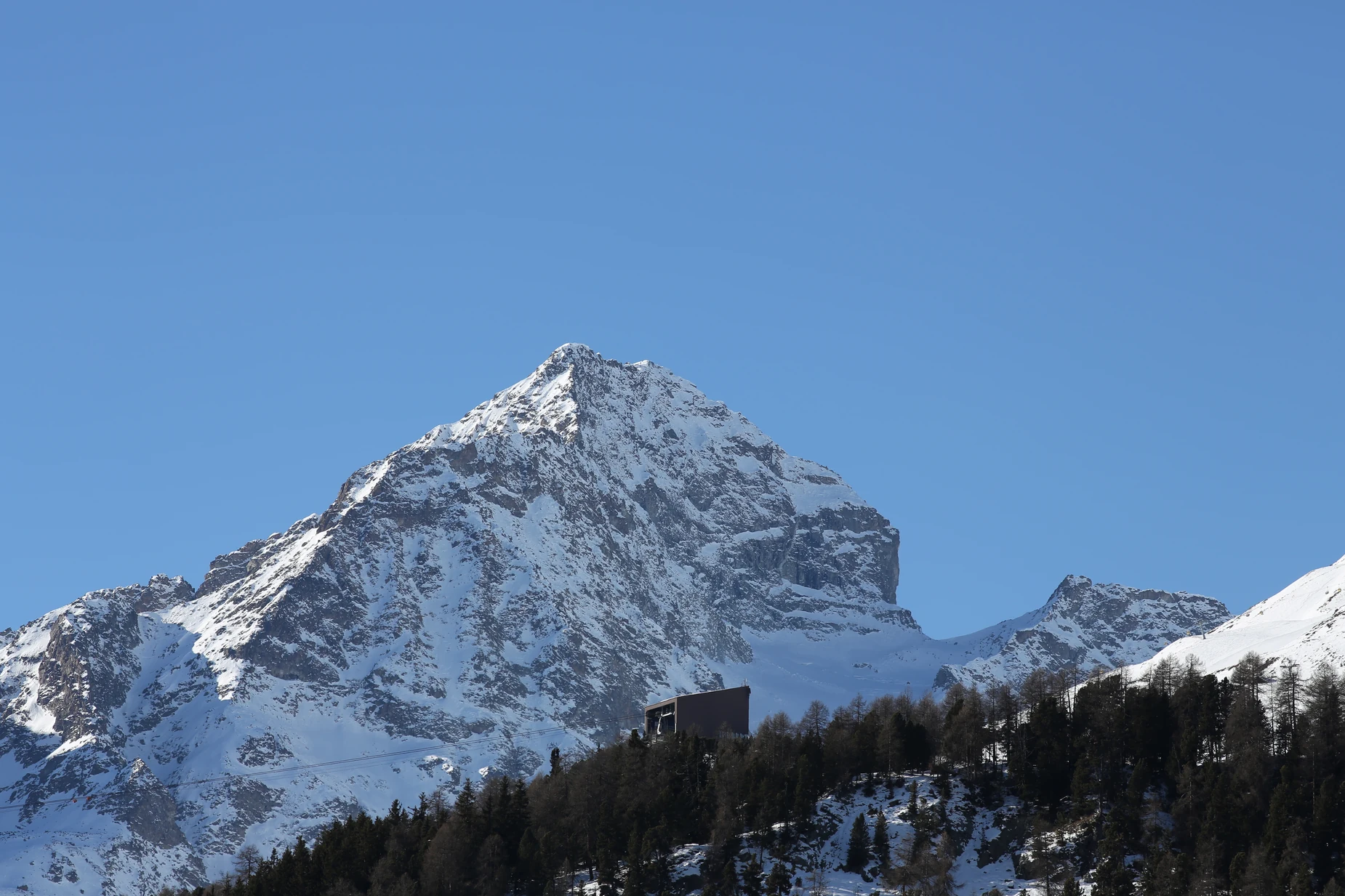
Granite, ice and an old mountain name
Granite walls rise above the Upper Engadine, with the Vadret Güglia glacier on the northeast side above Val Suvretta. To the southeast, the ridge dips to the Fuorcla Albana at 2,869 metres and rises again to Piz Albana at 3,099 metres.
In the Swiss Alpine Club yearbook of 1878, C. Kaufmann called the mountain Piz Julier or Munteratsch. The modern topographic map prints Munteratsch lower down, south of the summit.
The first recorded ascents
The Swiss Alpine Club’s route archive attributes the earliest recorded ascent to Jann Rüedi and J. Saraz on 12 July 1859. Kaufmann gives a firsthand record of his own climb on 27 August 1877 with guide Fortunat Methier and Heinrich Felix, who supervised work on the mountain trail. The owners of the Hotel Riv’alta in Silvaplana helped pay for the path, and Kaufmann described stone steps laid across awkward ledges. He doubted that the steeper ground above would ever suit a wider public.
On 22 June 1893, Emil Huber, M. Schneeli and their guide J. M. Gamma climbed the north flank and descended west. The Club Alpino Italiano’s journal reported this as the first ascent by that line in its November 1894 issue.
The 2024 Northwest Couloir
On 20 March 2024, Roger Schäli established the 600-metre Nordwestwand Couloir, a line of rock and ice that joins the north ridge. He had inspected the face on two previous outings and climbed alone, using a rope to belay himself on harder sections. He graded the couloir WI5+ for water ice and M5+ for mixed climbing.
In his 2025 account, Schäli recalled thin, snow-filled ice columns in the lower pitches. The climb continued on steep snow and exposed ridge terrain above, linking two distinct kinds of winter climbing in a single ascent.