
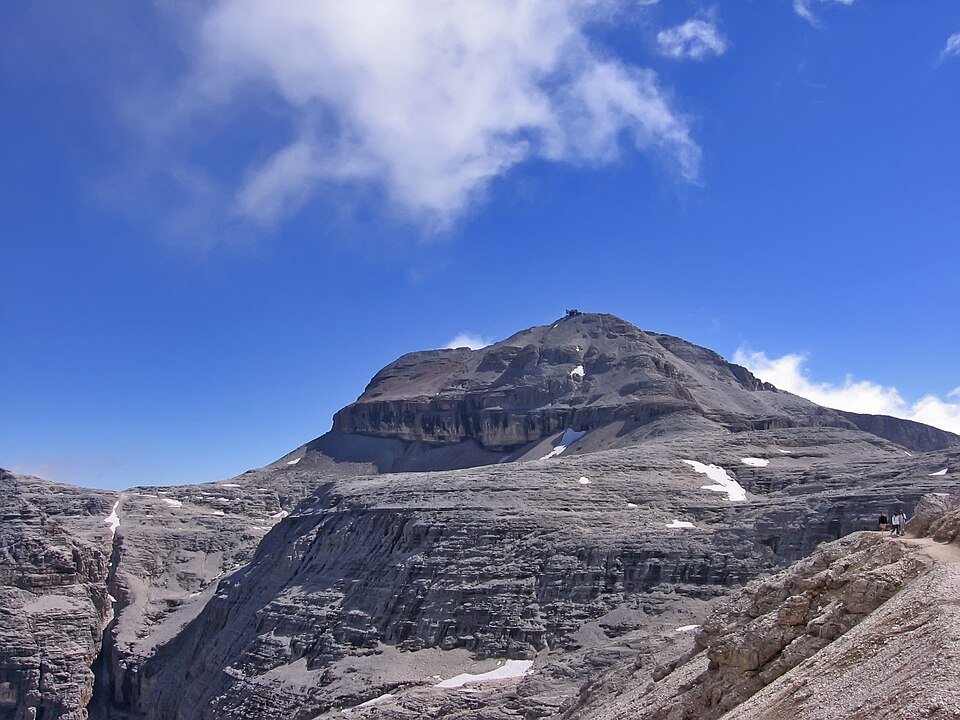
A Summit at the Boundary of Three Provinces
Piz Boè rises to 3,152 metres and is the highest peak of the Sella Group, one of the most distinctive massifs in the Dolomites for its tabular form. Its position at the boundary of Belluno, Bolzano, and Trento makes it a geographical and administrative meeting point for three distinct Alpine territories. The Ladin name coexists with the German designation Boespitze, reflecting the linguistic plurality of the surrounding area.
The Passo Pordoi Cable Car and Trail 627
The cable car departing from Passo Pordoi arrives at the Rifugio Maria, where a panoramic terrace offers a 360-degree view of the Dolomites at an elevation of 2,950 metres. From here, trail 627 descends to Forcella Pordoi at 2,829 metres — where the rifugio of the same name is located — before continuing to a junction. At that point, trail 627 is left in favour of trail 638, which leads towards the summit over easy rocky terrain. The entire route makes Piz Boè one of the least demanding three-thousanders in the Dolomites in terms of both technical difficulty and elevation gain.
The approaches to the summit are not limited to this itinerary: sources indicate at least four routes, with varying degrees of difficulty, confirming that the mountain offers a range of options while remaining comparatively straightforward overall relative to other Dolomite three-thousanders.
The Sella Group and the Geographical Context
The Sella Group is one of the most recognisable massifs in the Dolomites, characterised by its summit plateau that stands out sharply against the surrounding landscape. Piz Boè occupies its highest point and represents its mountaineering focal point. The tri-provincial position — between Belluno, Bolzano, and Trento — reflects the geographical and historical complexity of this area of the Dolomites, which has for decades been at the centre of mountain tourism that relies on the network of lifts and trails as the primary infrastructure for access to high altitude.