
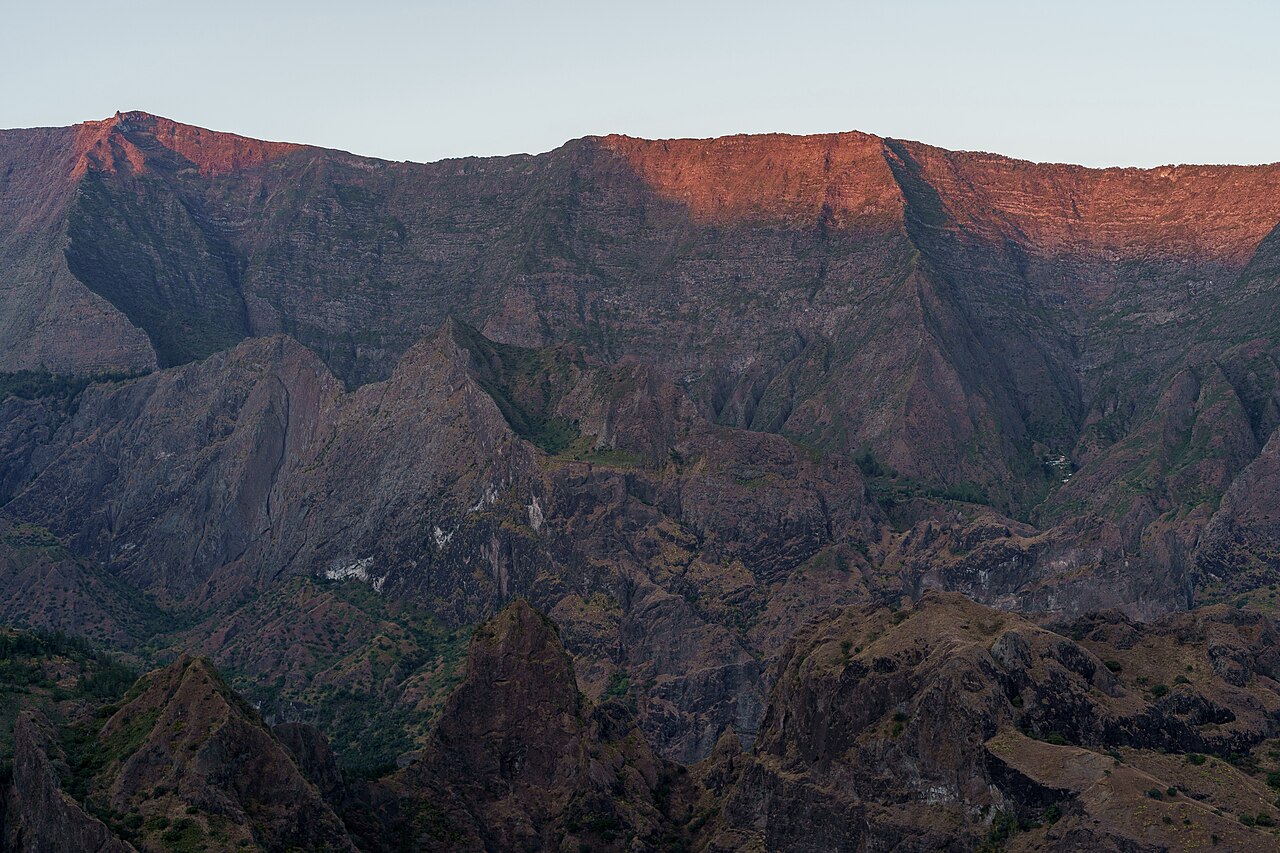
Western Escarpment and Plateau Morphology
BRGM geological surveys document the contrast between Maïdo's elevated plateau and the steep, heavily dissected slopes descending into the Mafate cirque below. The escarpment represents one of the most pronounced relief transitions in western Réunion, shaped by sustained erosion acting on the island's volcanic basement over geological time.
Maïdo Atmospheric Observatory
The Maïdo Observatory, situated at approximately 2,160 m and operating since 2012, forms part of the Network for the Detection of Atmospheric Composition Change. Its instrument suite includes lidar systems and spectroradiometers documented by NASA JPL and described in the facility's scientific commissioning paper in Atmospheric Measurement Techniques. At this elevation, the observatory periodically reaches above the marine boundary layer under suitable meteorological conditions, giving researchers direct access to free-tropospheric air masses.
Water Vapor Isotopes and Moisture Transport
A 2017 study published in the Journal of Geophysical Research used stable isotope ratios of water vapor measured at Maïdo station to trace the origin and atmospheric transport of moisture over western Réunion. By comparing isotopic signatures across varying humidity conditions, researchers linked distinct moisture sources to identifiable airflow patterns, advancing understanding of hydrological cycling in the southwestern Indian Ocean.