
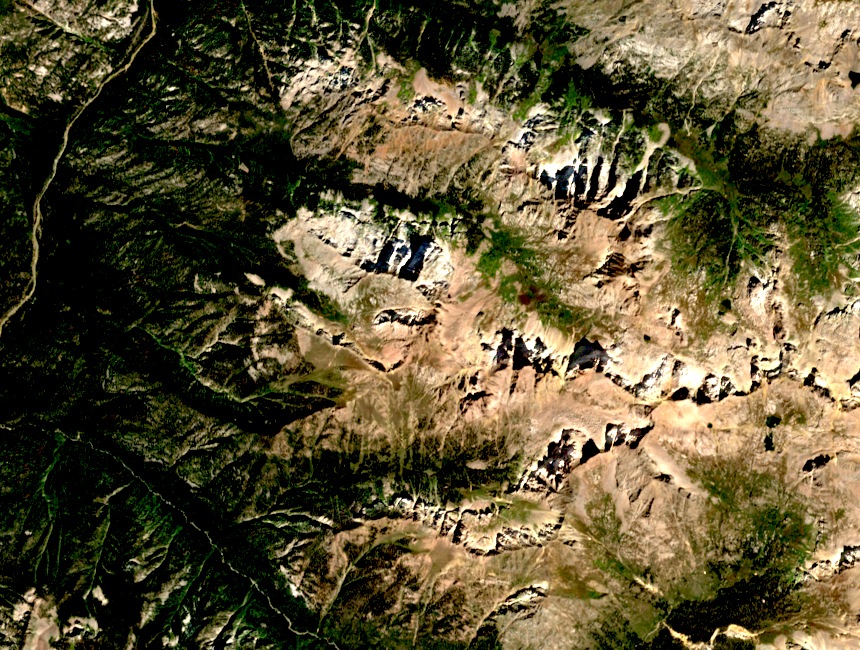
A Summit Apart in the Needle Mountains
The U.S. Board on Geographic Names lists Pigeon Peak as an independent summit, topographically separate from Eolus and Turret. Its elevation of about 4,260 meters places it just below Colorado's 14,000-foot threshold, yet the intervening ridgelines and terrain give it distinct standing within the Needle Mountains' dense concentration of high country.
Ancient Rock at the Surface
Pigeon Peak rests on Precambrian granitic rocks approximately 1.4 billion years old. USGS mapping identifies much of the Needle Mountains as Eolus granite, among Colorado's oldest exposed rock units. Glaciation subsequently carved the range's cirques and arêtes, shaping the jointed, steep-faced terrain and coarse pale stone characteristic of these summits.
Within the Weminuche Wilderness
Congress designated the Weminuche Wilderness in 1975, establishing the largest protected wilderness area in Colorado. Covering hundreds of thousands of acres across the San Juans, it extends well beyond the Needle Mountains into adjacent drainages and high plateaus. Pigeon Peak is one named summit within that broader protected geography.