
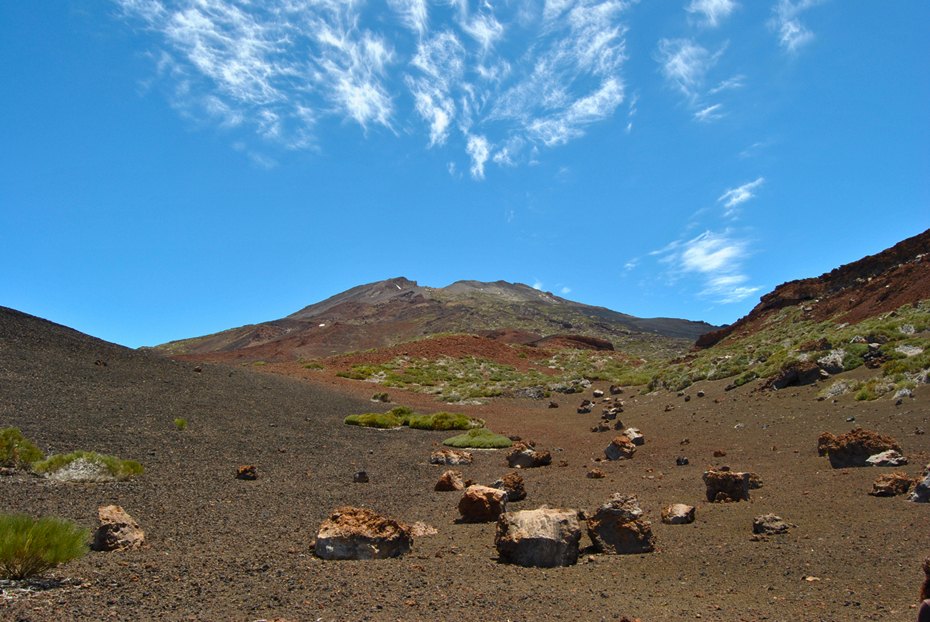
The Teide–Pico Viejo volcanic complex
Pico Viejo forms part of the Teide–Pico Viejo volcanic complex, whose formation began approximately 200,000 years ago in the centre of the island of Tenerife. Both volcanoes lie within the perimeter of Teide National Park. The crater of Pico Viejo is roughly 800 metres in diameter and is one of the satellite craters distributed around the Teide edifice, which reflects the structural interrelationship between the two summits.
The alternative name Montaña Chahorra is the one found in the Guanche tradition, while Pico Viejo has prevailed in modern official nomenclature. Both designations coexist in the historical and geographical documentation relating to the volcano.
The 1798 eruption and the Narices del Teide
In 1798, Pico Viejo erupted, giving rise to the formations known as the Narices del Teide (Nostrils of Teide). This event is historically significant for two reasons: it was the last recorded eruption within the boundaries of Teide National Park, and it was the longest among the historical eruptions of Tenerife, with volcanic material being emitted over three months.
This chronological distinction — the last eruption within the park and the longest in the island's recorded history — makes Pico Viejo a key reference in the study of active Canarian volcanism, and the Narices del Teide are the most visible morphological testimony of that eruptive episode.
Mythological dimension: the Guanche heritage
Both Pico Viejo under its Guanche name Montaña Chahorra and Teide are significant within Guanche mythology. The ancient inhabitants of Tenerife regarded these volcanoes as sites associated with deities — spaces of worship and supernatural presence. This symbolic dimension makes Pico Viejo not only a first-order geological reality but also a place of historical and cultural heritage value for the people of Tenerife, as recorded in the documented tradition.