
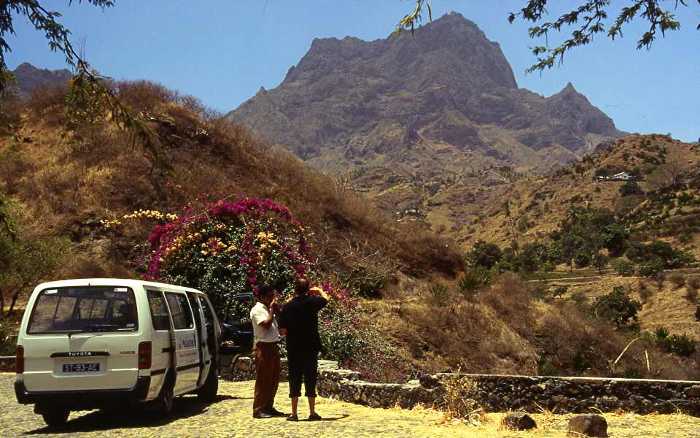
A Layered Volcanic Record
The mountain sits at the heart of what geologists call the Intermediate Volcanic Complex, formerly called the Pico da Antónia Formation, a sequence of eruptions dated broadly from roughly 3.3 to 2.2 million years ago. Rock belonging to this complex appears from the present coastline up to the summit. Holm and colleagues, writing in 2008, used argon dating of samples from the São Gonçalo section to place eruptions there between approximately 3.25 and 2.25 million years ago, attributing those flows to activity centred on Serra do Pico da Antónia.
In 2020, Marques and colleagues redrew part of the geological map after dating the rocks. At Águas Belas they found that certain underwater lava flows belonged to an older volcanic unit. In the Porto Rincão valley they identified another contact about 80 metres above the present sea. There, a lava flow that started on land continues into rock formed under water. The contact marks a past shoreline and helped the team identify periods when Santiago rose and others when it sank.
Protected Area and Park Boundaries
The area around the mountain entered Cabo Verde's protected network under a 2003 law. A December 2015 decree established the formal park boundaries, and an amendment published on 24 March 2022, Decree 37/2022 in the Boletim Oficial, republished the boundary description and gave the park an area of 2,935.57 hectares. The designation covers two connected zones: Rui Vaz and Serra do Pico de Antónia. The park carries the category Parque Natural.
The 2016 Key Biodiversity Areas assessment identifies the mountain range as internationally significant for species with restricted ranges. Nearly all of the assessed site falls within a protected area.
Upper-Slope Ecology and Endemic Species
The 2016 KBA assessment describes the upper slopes receiving persistent mist and drizzle, with eucalyptus stands managed by the state forestry service. Coffee is cultivated higher on the mountain, while maize and bean plots occupy lower ground. Among the endemic species documented around the mountain, the assessment records the Cabo Verde warbler Acrocephalus brevipennis and the plant Sonchus daltonii.
The assessment also reports that Fea’s petrels (Pterodroma feae) were observed breeding in the area in the 1960s. The assessment cited no more recent records.