
Alkaline rock and the origin of the name
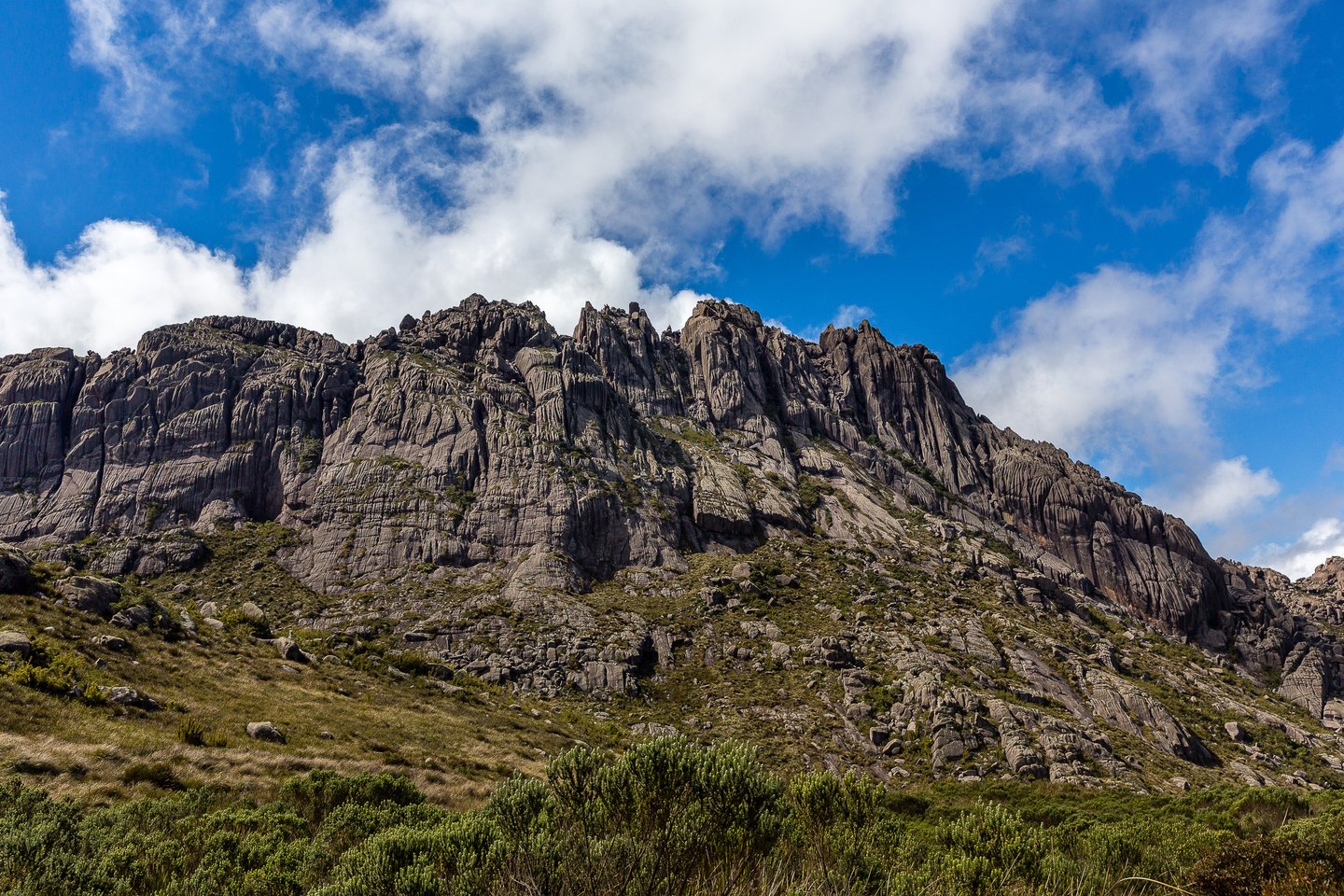
The visual identity of Pico das Agulhas Negras is inseparable from the rock that composes it. The Geological Survey of Brazil and ICMBio describe the presence of nepheline syenite, a highly soluble alkaline rock that, worked by erosion over millennia, forms grooves, flutes, and sharp ridges on the slopes and high-altitude channels. It is these features — dark, jagged, projected against the sky — that gave the mountain its name: the black needles.
It is worth noting that, although the alkaline geology of Itatiaia is associated with deep magmatic processes, neither the SGB nor ICMBio describes the summit as a preserved volcanic cone. The present morphology is the result of a long history of uplift, intrusion, and differential erosion — a process that shaped not only the main peak but the entire upper plateau of the park.
Watershed and high-altitude landscape
The Itatiaia plateau functions as a first-order hydrographic divide. ICMBio research identifies that the headwaters formed on the mountain's slopes feed two distinct basins: the Rio Grande basin, which drains toward the Paraná system, and the Rio Paraíba do Sul basin, which flows toward the coast of Rio de Janeiro state. This position as a watershed gives the massif a hydrological significance that extends beyond its physical dimensions.
The upper reaches of Itatiaia bring together high-altitude grasslands, rocky outcrops, and vegetation adapted to the low temperatures and intense solar radiation characteristic of the zone above two thousand meters. In this setting, Pico das Agulhas Negras and the formations that surround it compose a landscape of striking contrast with the forests that cover the lower slopes of the range.
Brazil's first national park
Itatiaia National Park was established in 1937, making it Brazil's first national park. This historical milestone predates most of the country's conservation units by decades and reflects an early recognition of the singular character of the Itatiaia mountain environment. The plateau sector, where Pico das Agulhas Negras is located, concentrates the high-altitude formations that helped motivate that interest.
The history of the park is also a history of accumulated scientific knowledge. The Research Bulletin of Itatiaia National Park, published by ICMBio, documents decades of studies on the region's flora, fauna, geology, and hydrology — a body of work that places Itatiaia among the most thoroughly studied protected areas in Brazil. Government records also point to the presence of cultural facilities integrated into the history of the park, reflecting a trajectory that combines environmental conservation and institutional memory.