
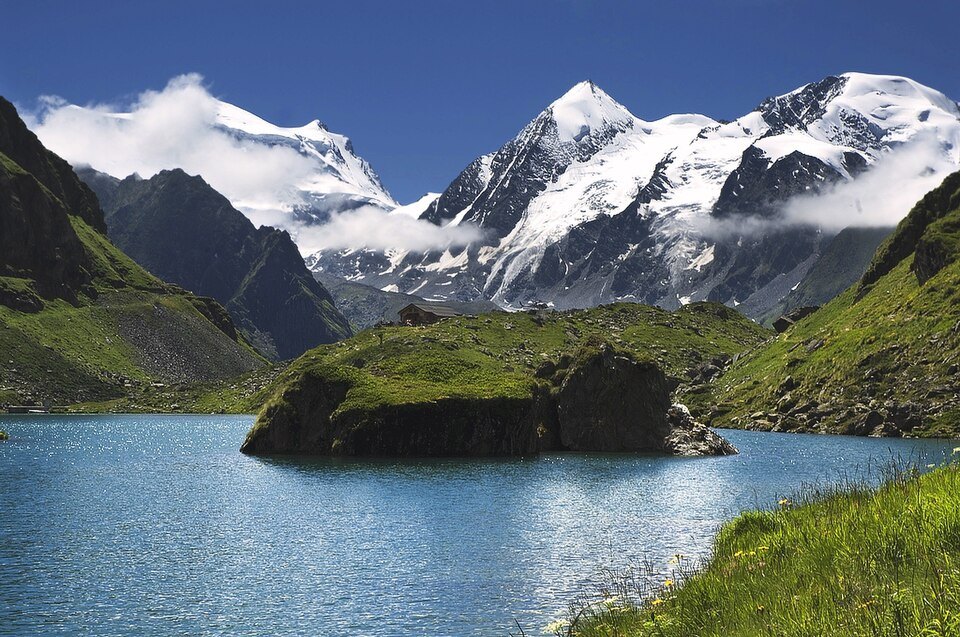
A summit of many ridges
What immediately sets the Petit Combin apart from the other summits of its massif is the complexity of its topography. From the summit plateau — a broad snowy surface some 300 metres long by 200 metres wide — no fewer than five distinct ridges radiate outward. One of them, the north-east ridge, in turn divides into two branches, bringing to six the total number of ridge lines issuing from the plateau. This unusual branching gives the mountain a strongly articulated relief, very different from the classic conical profile of high Alpine summits.
This architecture is more than a geographical detail: it directly determines the possibilities for approach and ascent. Each ridge defines a potential route, a particular exposure to wind and sun, specific snow and ice conditions. The Swiss Alpine Club describes the Petit Combin as "a very bulky mountain with strongly branching topography," underlining that this complexity is a fundamental characteristic of the summit, not an incidental feature.
Between the Val d'Entremont and the Corbassière Glacier
The Petit Combin occupies a pivotal position in the geography of Valais. To the west it dominates the Val d'Entremont and the village of Bourg-Saint-Pierre, one of the historic crossing points toward the Great St Bernard Pass. To the east it overlooks the Corbassière Glacier, one of the great glaciers of the massif. This duality — an inhabited slope on one side, a glacial world on the other — is characteristic of Pennine summits that link the populated valleys of Valais with the high frozen uplands.
The north face of the Petit Combin is covered by the Petit Combin Glacier, which contributes to the permanent snow cover of that aspect. The combined presence of the summit plateau and this north-facing glacier gives the peak a lasting snow reserve that shapes ascent conditions from season to season and year to year.
The summit plateau as a morphological peculiarity
Few Alpine summits end in a true snow plateau rather than a single sharp high point. The one on the Petit Combin, measuring 200 metres by 300 metres, represents a notable morphological singularity in the Pennine Alps. This type of summit form generally results from ancient glacial erosion having planed down the relief, combined with the persistence of a permanent snow cover that preserves the flatness of the surface.
It is from this plateau that the five main ridges radiate, in an arrangement reminiscent of leaf veins or the arms of a flattened star. This geometry makes the plateau simultaneously a topographic crossroads and a transitional space between the world of airy ridges and that of ice-clad faces. For mountaineers who reach this point, the plateau offers a moment of decompression before or after the most demanding sections.
Position within the Combins massif
The Petit Combin belongs to the Combins massif, in the Swiss Pennine Alps, canton of Valais. It sits north of the Combin de Corbassière, from which it is distinct despite the closeness of the names. The Combins massif forms one of the great mountain entities of Valais, between the Rhône valley to the north and the Italian border to the south, characterised by vast glaciers and summits exceeding 4,000 metres at the highest points of the group.
At 3,668 metres, the Petit Combin does not rank among the giants of the massif, but its branching topography and the extent of its summit plateau give it a presence in the Alpine landscape disproportionate to its absolute altitude. Its name, designating it as the "little" counterpart of the higher Combins, should not obscure the reality of a mountain of character whose singular structure continues to attract the attention of geographers and mountaineers alike.