
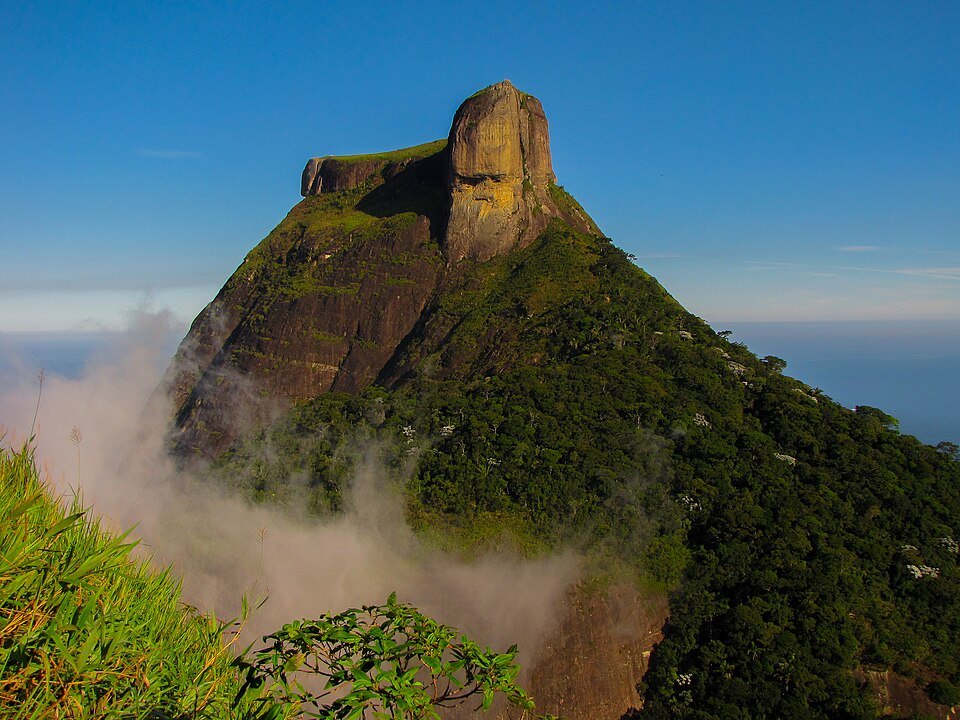
A Silhouette That Named a Continent
The name Pedra da Gávea has a precise origin in the expedition of Captain Gaspar de Lemos in 1501 — a voyage in which Amerigo Vespucci also took part and during which the bay of Rio de Janeiro, today known as Guanabara Bay, also received its name. The sailors of the expedition, upon sighting the massif from the sea, recognized in its silhouette the shape of a crow's nest, the observation platform mounted on the masts of the ships of the era. Thus, Pedra da Gávea is among the first natural formations in Brazil to receive a name in the Portuguese language.
This nautical christening reveals how the relief of the carioca coast served as a navigational reference for the first Europeans to explore the South American coastline. The mountain was a landmark visible from the sea before any detailed cartographic charts existed, and its unmistakable shape made it a natural point of orientation in the centuries that followed.
Geology and Singular Coastal Position
The granite and gneiss composition of Pedra da Gávea is characteristic of the crystalline basement of southeastern Brazil, but what truly distinguishes the massif is its relationship with the ocean. With 842 meters of altitude and a base at virtually sea level, it belongs to a restricted group of mountains considered among the highest in the world on oceanic margins — a geomorphological category that combines absolute elevation with the absence of transitional terrain between summit and water.
The monolith lies within the Tijuca Forest, the largest tropical urban forest on the planet, and its management today falls to Tijuca National Park. This status of formal protection consolidates the preservation both of the Atlantic Forest ecosystem that surrounds it and of the integrity of the rock massif itself.
Trails Opened in 1830
The trails that today traverse the flanks of Pedra da Gávea did not originate from modern hiking: they were opened in 1830 by the local agricultural population, who needed access routes across the steep terrain of the hillside. This chronological detail places the mountain within a period when the Tijuca Forest still harbored farms and sugar mills, before the imperial reforestation project that would transform the region in the following decades. The paths opened by rural workers became, over time, the same routes used for sporting and scientific exploration.
The Contested Inscription
One of the most debated questions surrounding Pedra da Gávea involves visible marks on its rock faces, interpreted by some researchers over the centuries as inscriptions of human origin — a hypothesis that has fueled theories about a pre-Columbian presence of Mediterranean peoples or other ancient civilizations. What appeared to be a sculpted face and written characters in the stone generated considerable speculation.
In the mid-1950s, Brazil's Ministry of Education and Health formally took a position on the matter, declaring that the examination conducted by geologists had proved them to be nothing more than the effect of erosion over time, and not any form of writing. The majority of contemporary researchers reach a similar conclusion, attributing both the markings and the face-like feature to natural weathering processes. The controversy, however, remains alive in some circles and contributes to the mythical character that surrounds the monolith.