
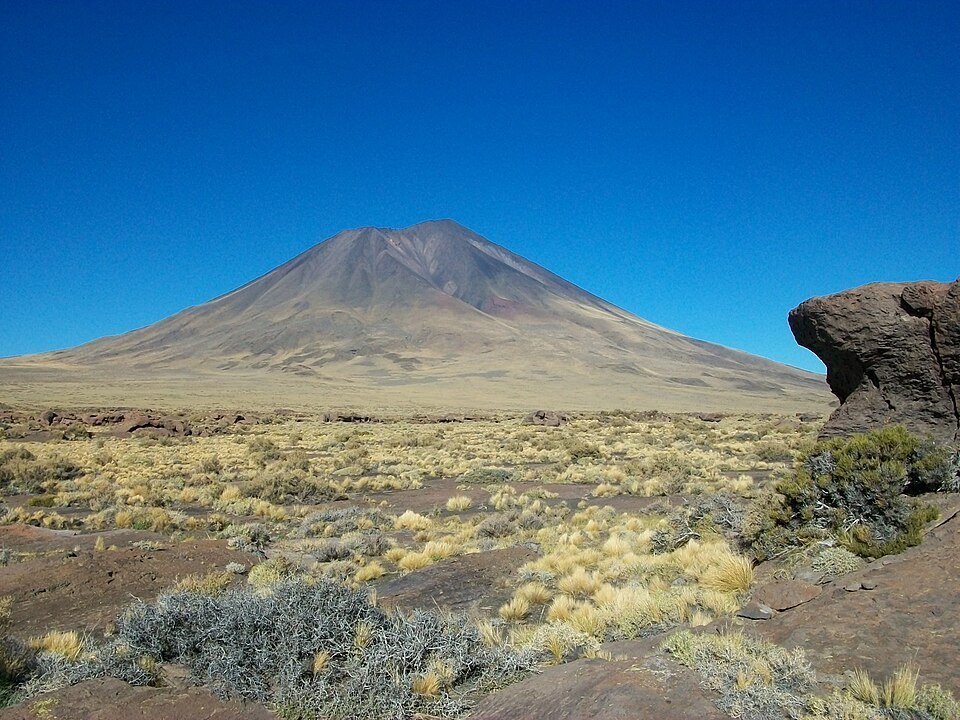
Profiles of the volcanic field
Payún Liso has steep flanks and a well-defined cone. Payún Matrú, the other composite centre of the field, is organised around a broad central caldera. The Smithsonian Global Volcanism Program records the variant Cerro Payén for this stratovolcano and lists 3,796 m, although different sources give approximate elevations between 3,715 and 3,800 m.
Fissure structures in La Payunia
Across the surface of La Payunia, in addition to the two composite volcanoes, there are groups of scoria cones and basaltic lava flows originating from fissure vents. These structures attest to the variety of eruptive mechanisms in the volcanic field.
Back-arc field
La Payunia lies east of the Andean arc, a position that defines its character as a back-arc volcanic field. A geochronological study by Germa and colleagues estimates that the construction of Payún Liso occurred around 265,000 years ago, based on K-Ar dating.