
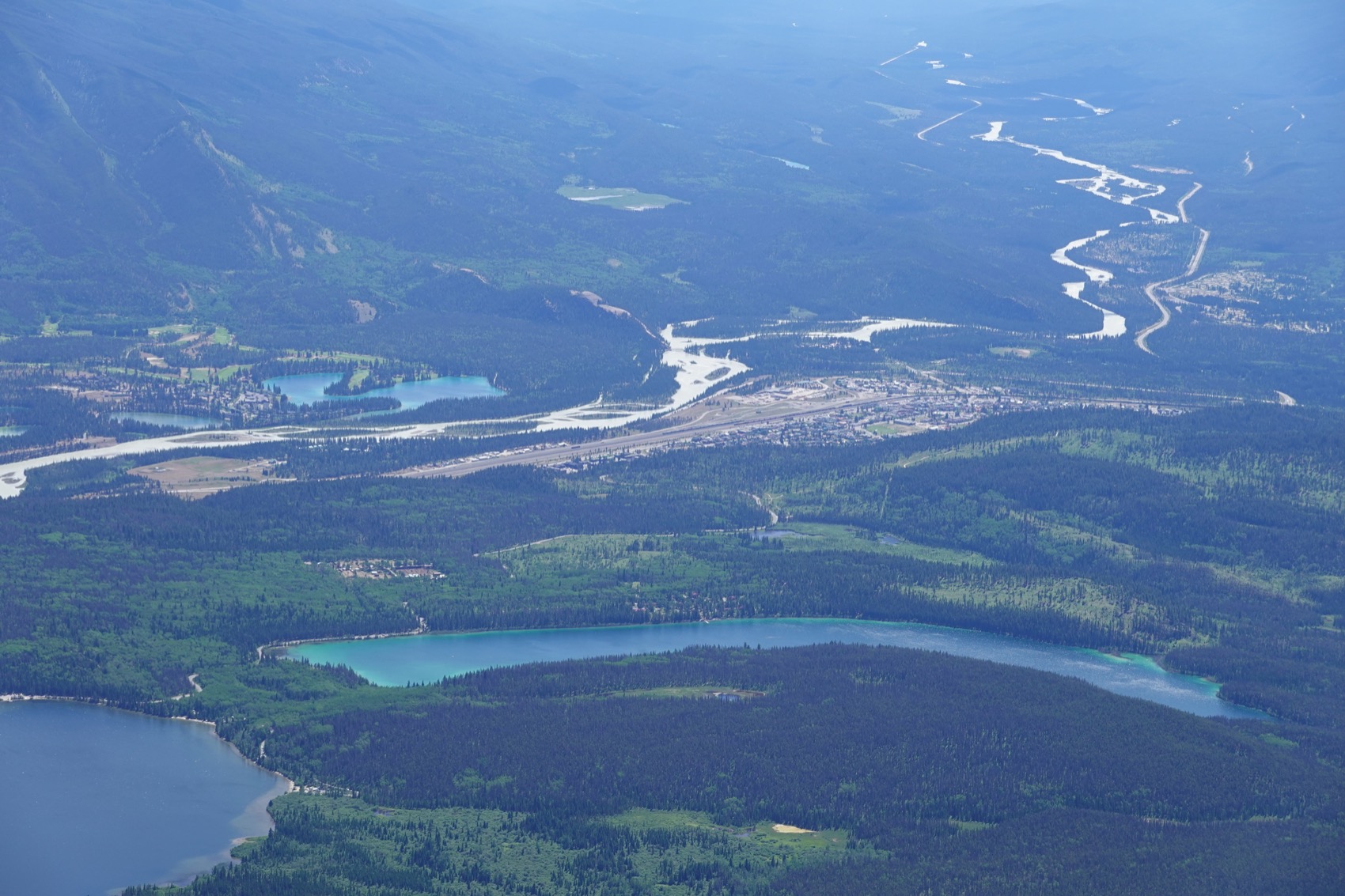
A Finger Lake Shaped by Ice
Parks Canada classifies Patricia Lake and nearby Pyramid Lake as finger lakes, basins formed by the scouring action of moving glacial ice within the Athabasca Valley. The result is a body of water elongated in plan, its geometry still legible from elevated vantage points such as the summit of Pyramid Mountain, from which the 12 July 2024 photograph reproduced here was taken.
The lake carried the name Lake Patricia in the 1928 National Parks Branch guide to Jasper, where it was described as named for Princess Patricia of Connaught, daughter of the Duke of Connaught, who served as Governor General of Canada. The official place-name decision by the Canadian Geographical Names Data Base is dated 7 February 1951, registering the name as a lake. Jasper National Park forms part of the Canadian Rocky Mountain Parks World Heritage property, inscribed by UNESCO in 1984.
The 1943 Habbakuk Prototype
In mid-February 1943 the National Research Council of Canada began constructing a floating test structure on the frozen lake as part of the British-led Habbakuk project, which sought to establish a mid-Atlantic base for aircraft operating against submarine threats. The completed model measured approximately 18 by 9 metres and was built from ordinary lake ice within a timber casing with insulation. It was housed beneath a protective roof that made it resemble a boathouse from the outside. Refrigeration was achieved by circulating cold air, with cooling machinery functioning by 10 April 1943. The NRC selected the site in part for its proximity to rail access and for the secrecy the location afforded. Conscientious objectors contributed labour during construction. Researchers tested pykrete, a composite of wood pulp and ice, as a material for the proposed full-scale vessel. The project ended before that vessel was built.
After refrigeration was withdrawn, the model remained afloat through the summer before eventually sinking. Rising costs and the increasing effectiveness of conventional air and naval coverage contributed to the project's cancellation.
What Researchers Found Underwater
Susan B. M. Langley led an archaeological study whose findings were published in Scientia Canadensis, volume 10, number 2, in 1986. The study documented timber walls, ductwork, and asphalt insulation on the lake bed. Parks Canada conducted a separate underwater survey in October 1992 to inventory the cultural remains of the structure.