
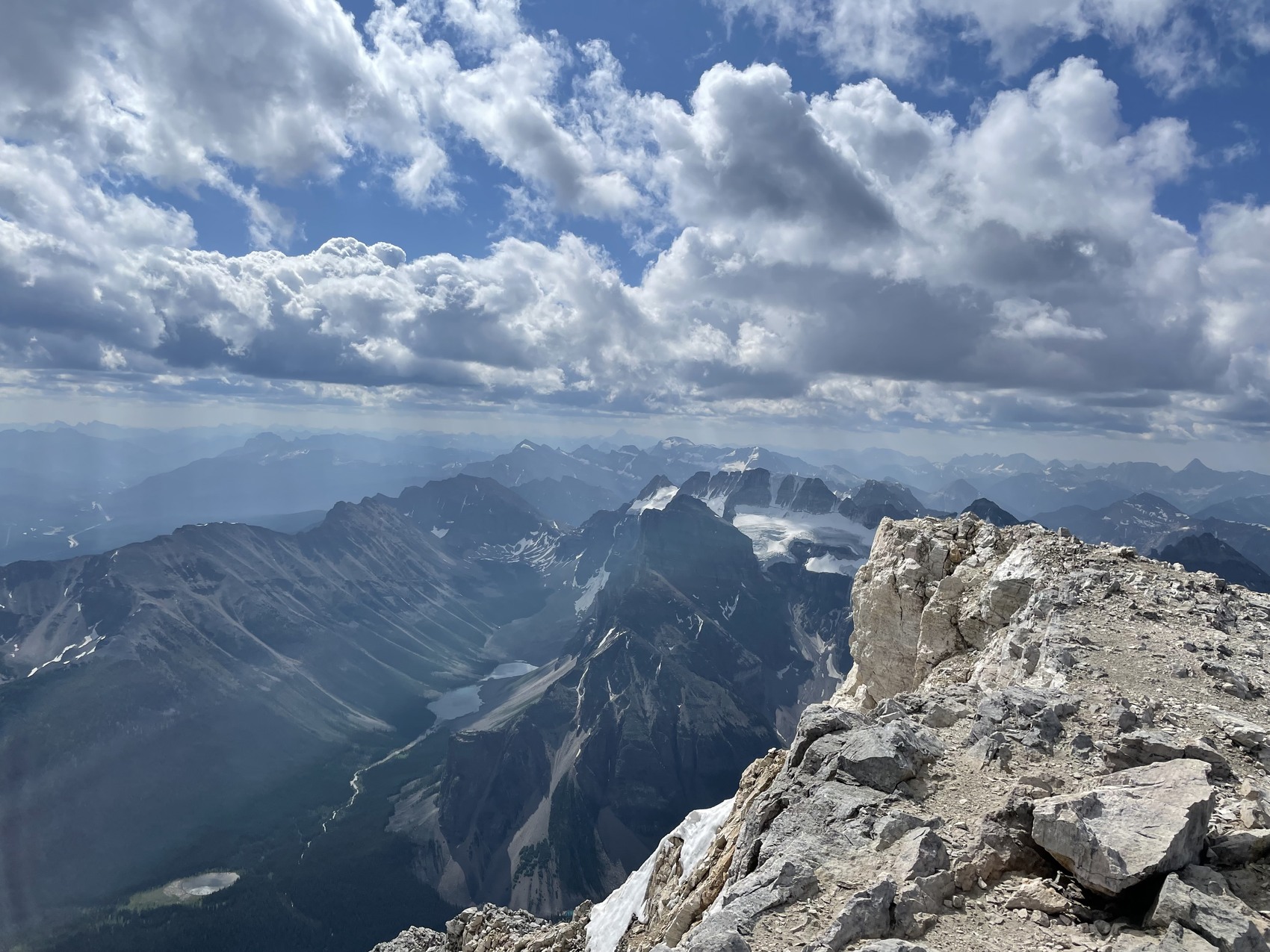
Position and Name
Parks Canada's Lake Louise and Bow Valley Parkway map places the ridge between Consolation Lakes to the west and Taylor Pass to the south, with Taylor Lake lying to the east beyond the ridge's eastern flank. The name appears in the Canadian Alpine Journal for 1942–43, predating the official naming decision of 7 May 1959 recorded by Natural Resources Canada.
Geology Recorded in 1942
During a two-week July 1942 camp at Consolation Lake, geologist W. H. Mathews mapped the ridge's exposed rock sequence and published his findings in the 1942–43 Canadian Alpine Journal (pp. 71–72). The lowest unit he identified was a thin, possibly discontinuous layer of Fairview Formation conglomerate, which he interpreted as ancient shoreline gravel. Above this lay Fairview Formation quartzite, recrystallised from sand. Overlying the quartzite was an iron-rich, reddish Lake Louise Formation shale derived from mud, with pale or pink quartzite making up the highest slopes. Mathews also produced topographical cross-sections illustrating the ridge's position between the two flanking valleys.
Valley Glaciation and Talus
Mathews identified a narrow terrace on the east side of Consolation Valley as an old lateral moraine standing roughly 1,000 feet (about 300 metres) above the valley floor, evidence of former glacier extent in the drainage. Across the valley, a 1966 field photograph taken from Panorama Ridge — published as Plate 12 of Debris Slope Form and Processes in the Canadian Rockies — shows scree slopes below the northeastern face of Mount Babel that the study identified as subject to rockfalls, documenting the slope dynamics visible from the ridge at that time rather than conditions on the ridge itself.