
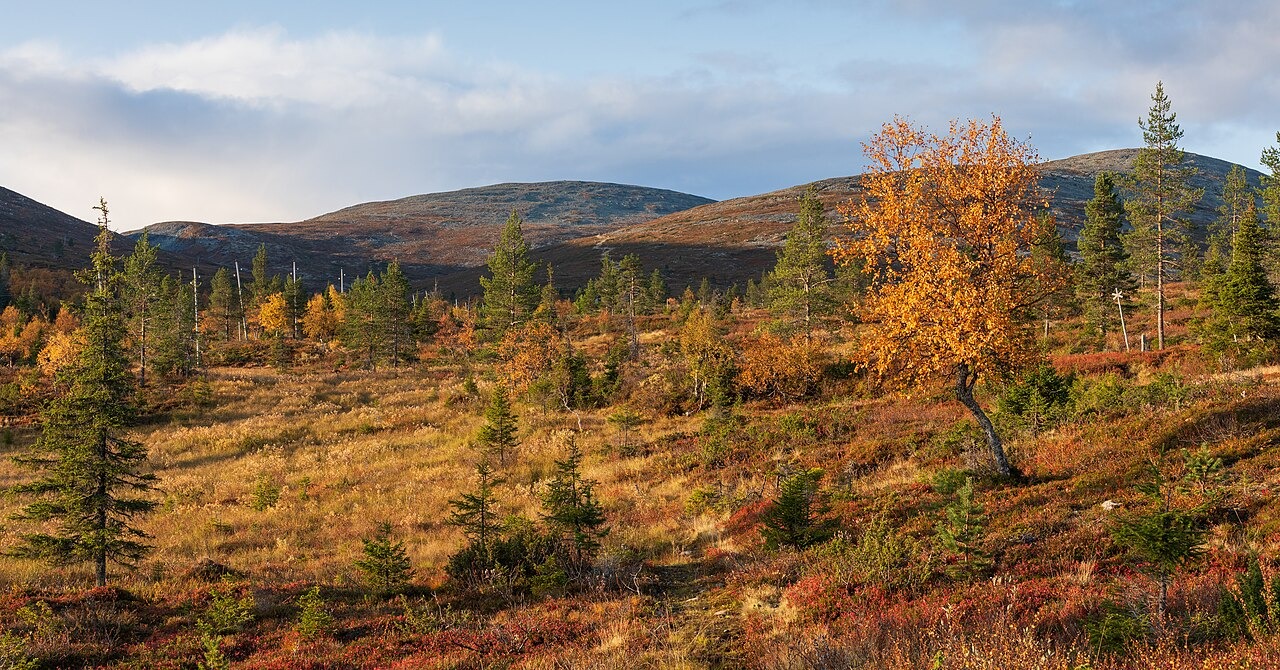
The Fell Group and Its Summits
The Pallastunturi group contains several individually named fells, among them Taivaskero and Pyhäkero. Metsähallitus identifies Taivaskero as the high point at 807 metres. The Finnish Meteorological Institute associates the fell landscape with mafic volcanic bedrock and notes variation in plant communities across the group, though detailed botanical characterisation applies at the group scale rather than to individual summits.
The 1952 Olympic Flame Relay
On 8 July 1952, the Midnight Sun Flame was lit at the summit of Taivaskero and carried by relay to Tornio, where the City of Tornio records a ceremony joining it with the flame brought from Greece. The combined flame then continued to Helsinki for the Summer Olympic Games. A plaque at the Taivaskero summit commemorates the lighting, and Metsähallitus marks the event in the park's history.
Atmospheric Monitoring at Sammaltunturi
Scientific observation of the fell landscape began with a station near Lake Pallasjärvi in 1935. The Finnish Meteorological Institute established a long-term atmospheric monitoring station on Sammaltunturi, a summit adjacent to the Pallastunturi group, with summit-level observations beginning in 1991. The station contributes to baseline measurements of atmospheric composition and climate variables across northern Finland.