
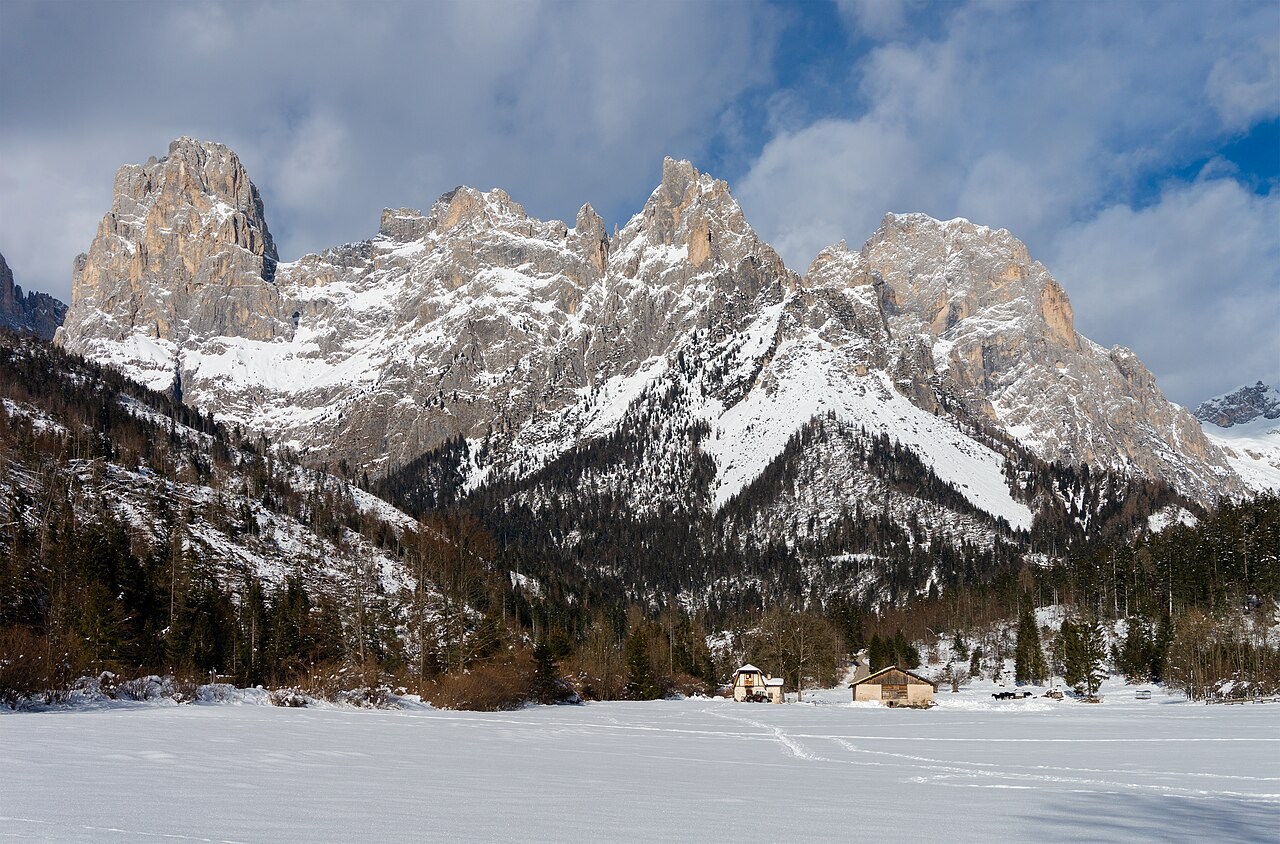
Geology: the Sciliar Dolomite and its marine origins
The great pale faces that define the group's profile belong largely to the Sciliar Dolomite, a rock formation deposited in a marine environment during the Triassic. The considerable thicknesses of this dolomite preserve the structural imprint of ancient tropical atolls, whose geometry remains legible in the sedimentary characteristics of the rock. It is the nature of this formation — compact, massive, and highly resistant to erosion — that determines the verticality and pale colour of the faces that visually distinguish the massif.
Karst processes and underground water circulation
The dolomite of the massif is traversed by a system of fractures and karst features that profoundly condition water circulation. As documented in the hydrogeological studies of the Paneveggio Pale di San Martino Natural Park, rainwater and snowmelt do not flow only on the surface but penetrate through discontinuities in the rock, feeding aquifers and springs at lower elevations. This hydraulic behaviour is distinct from the morphology of the external faces: the same rocks that appear compact and vertical on the surface conceal internally a network of passages and cavities that make it an active and complex hydrogeological system.
Geographic extent and highest point
Cima Vezzana, at 3,192 metres, is the highest point of the entire group, but does not represent a summary elevation for the massif as a whole: the Pale comprise a vast summit plateau and numerous peaks of varying height, each with its own character. The group extends discontinuously across Trentino and Veneto, and its administrative fragmentation reflects the geographical complexity of a mountain system that cannot be reduced to a single boundary or a single representative altitude.