
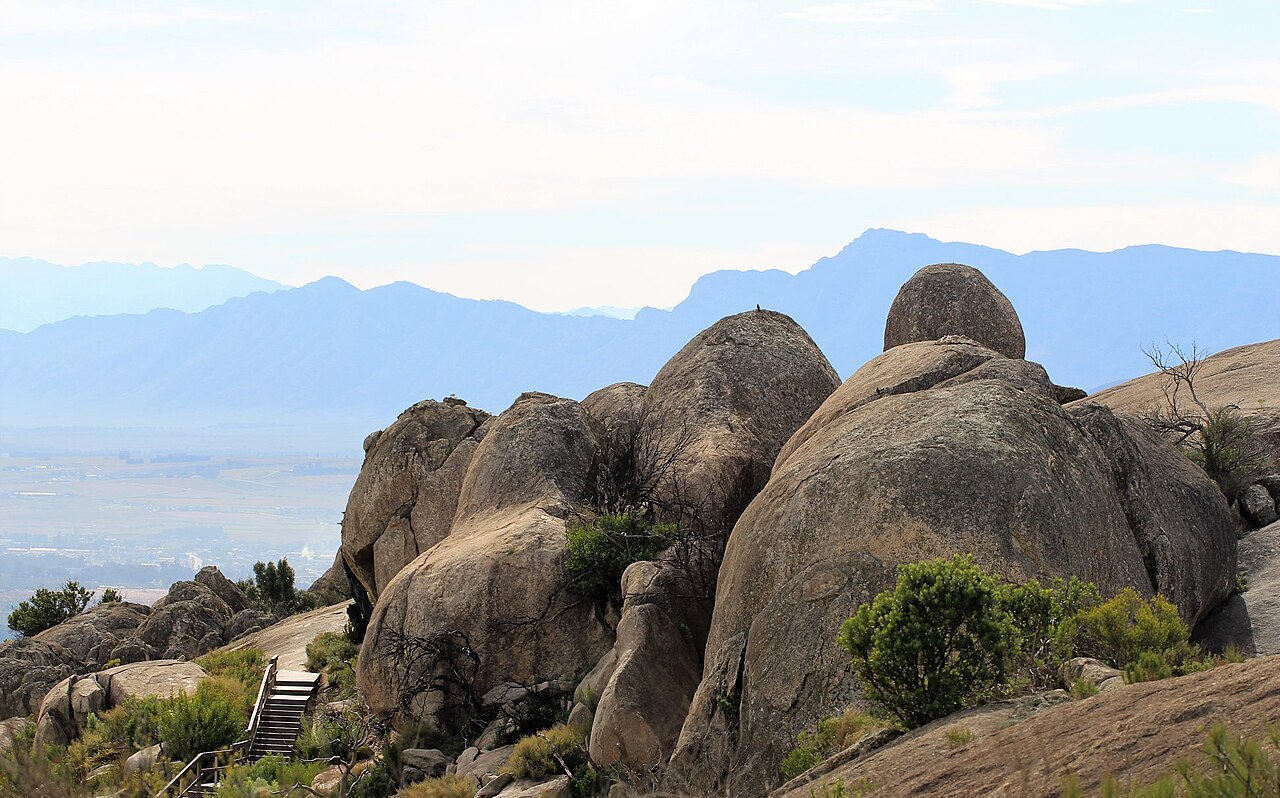
Granite Domes Shaped by Subsurface Cooling and Exfoliation
The domes of Paarl Mountain originated as granite that cooled and solidified underground before overlying rock eroded away over geological time. The outer layers of the exposed granite peeled away in curved sheets, a process of exfoliation that progressively rounded the domes into the forms visible today. Paarl Rock, the most prominent dome, rises alongside Bretagne and Gordon's Rock across the upper mountain.
Abraham Gabbema's 1657 Record of Peerleberg
The Dutch name Peerleberg appears in a colonial archive entry attributed to Abraham Gabbema in 1657, recorded in connection with the glistening appearance of the wet granite domes. SANBI's historical account of Paarl Mountain documents this naming within the Dutch colonial record of the Cape. The settlement that grew below the mountain took its name from the same source, linking the place name to the domes that defined the landscape for early European visitors.
Conservation Milestones and the Municipal Nature Reserve
Paarl Mountain received formal heritage recognition when it was declared a National Monument in 1963. Seven years later, in 1970, the municipal commonage was granted for use as a nature reserve, extending protection to the fynbos vegetation and associated habitat across the slopes. The Drakenstein Municipality now administers Paarl Mountain Nature Reserve, maintaining the landscape that encompasses the granite domes, indigenous scrub, and wild olive stands documented in the reserve's natural history.