
Landform and Setting
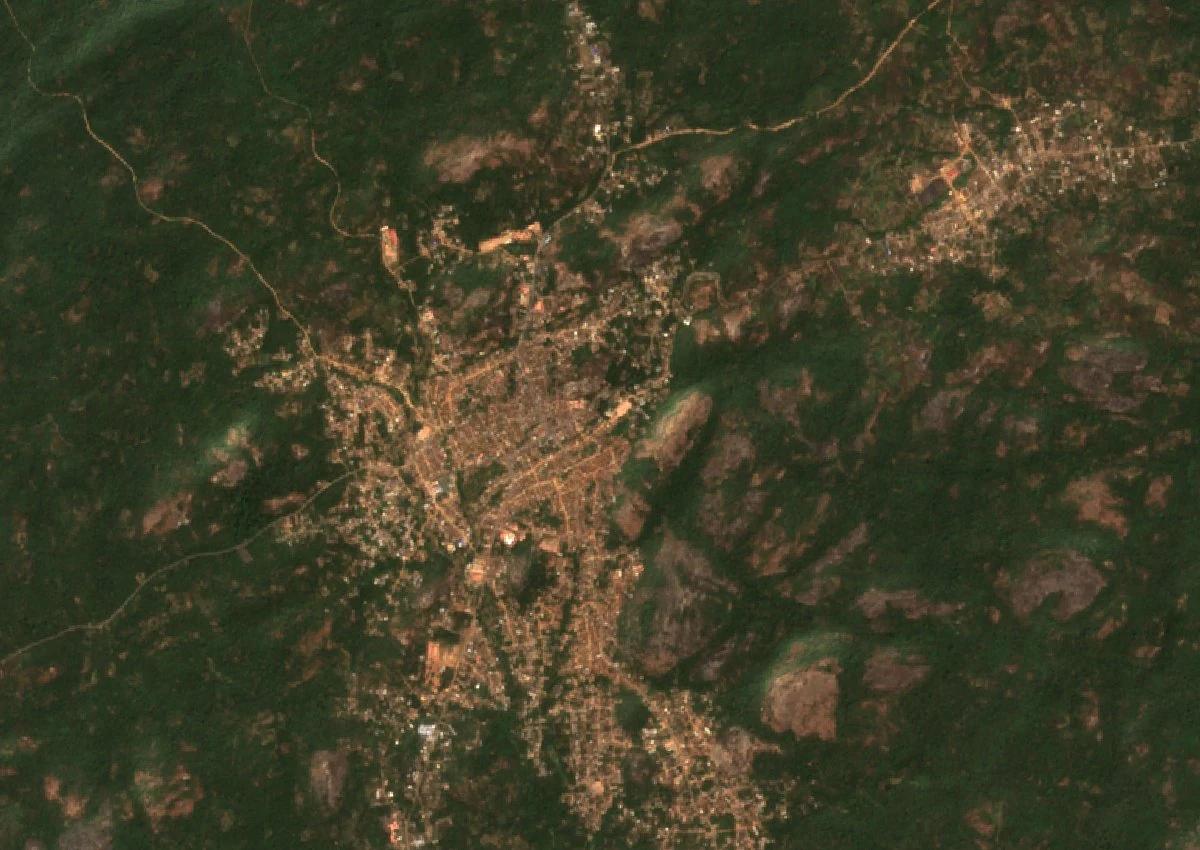
The Oke Emo quarter occupies the northeastern part of Ilawe-Ekiti's built-up area, as shown in a 2015 field survey reproduced in a 2017 research paper by Senator Endurance Okosun mapping the town's ward boundaries. A Sentinel-2A satellite image acquired on 20 December 2024 shows higher ground to the east of the settlement, with lower cultivated areas surrounding the town and rounded, partly exposed rock visible near a wooded hillside. The higher ground in the Oke Emo ward reaches about 590 metres in Copernicus elevation data. Ilawe-Ekiti sits within Ekiti State, which was created from the former Ondo State in 1996.
Geology and Rock Outcrops
The broader Ilawe-Ekiti area sits on ancient crystalline basement. Geological surveys and published field studies identify migmatite-gneiss, granite, quartzite, and quartz schist within the area around the town, and granite outcrops and inselbergs are documented nearby. On hills underlain by such basement rocks, differential weathering strips softer material from the surface while more resistant masses remain as exposed outcrops or rounded domes, a process consistent with the bare and partly exposed rock visible on hillsides in this landscape.
Imo Erebe and Oral Tradition
Within the Oke Emo quarter, fieldwork by Fadamiro, Adedeji, and Ibrahim published in 2012 identifies an open space called Imo Erebe. That study records an oral tradition in which a chief named Elero came from Ile-Ife and founded the settlement associated with that ground. The same space is recorded as the site where the ceremony of the town ruler taking office was held, according to the same study. Interviews conducted in Ilawe-Ekiti in 2019 and reported by the Nigerian newspaper Vanguard provide further testimony from residents and chiefs that the hill holds spiritual significance for the community.
Civic Uses of Imo Erebe
The 2012 study by Fadamiro, Adedeji, and Ibrahim recorded that Imo Erebe served as a layered public space with tiered seating, used for a range of community activities. Documented uses included communal prayers and voter registration, reflecting an administrative and civic dimension alongside everyday social life. The study also noted recreational use through ayo olopon, a board game played at the space.