
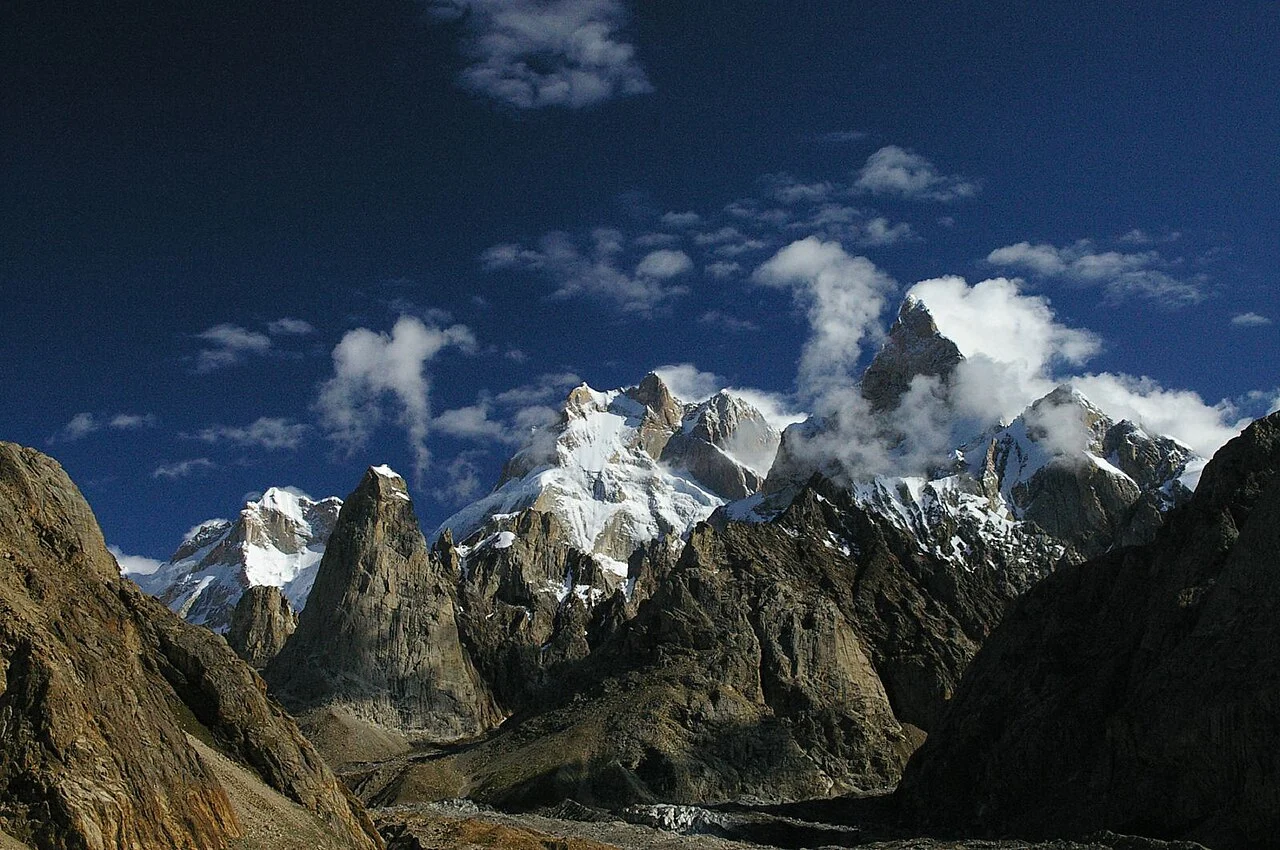
The 1977 First Ascent
On 13 July 1977, Chris Bonington and Doug Scott reached the summit of Baintha Brakk by the west ridge, completing the mountain's first ascent. The pair were supported by expedition teammates throughout a climb that demanded technical commitment on a peak of Karakoram scale.
The descent proved exceptionally arduous. During a rappel, Scott sustained leg injuries that complicated the team's return through the crevassed and exposed terrain below the summit. The expedition's other members played a role in bringing the party down; the full account is documented in Bonington's report in the American Alpine Journal. The episode became part of the mountain's recorded history, cited in subsequent expedition literature as an illustration of Baintha Brakk's objective difficulty.
Twenty-Four Years Without a Second Ascent
Between 1977 and 2001 no party succeeded in repeating the summit, an interval of twenty-four years that Thomas Huber's account of the second ascent acknowledges directly. The route Huber's team chose — the south pillar — was a distinct line from the original west-ridge approach.
On 21 July 2001, Thomas Huber, Urs Stöcker, and Iwan Wolf reached the main summit. Their team had also climbed Ogre III on 1 July of the same expedition, though that ascent was of a separate and distinct summit within the group. Huber's report in the American Alpine Journal provides the primary documentation for both ascents and establishes the 7,285-metre figure associated with the main peak.
The Ogre Massif and Its Summits
The name "the Ogre" in alpinist usage most often refers to Baintha Brakk, the highest point of the group, but the massif includes Ogre II and Ogre III as recognised independent objectives. The 2001 expedition's separate ascent of Ogre III on 1 July — three weeks before the main summit — illustrates how the cluster presents distinct challenges rather than a single mountaineering theatre.
Baintha Brakk and the Ogre are used as synonymous references to the same 7,285-metre summit, as Huber's account treats them. This peak is distinct from the separate objectives known as Ogre II and Ogre III.
Position in the Karakoram
The Panmah Muztagh is one of the subsidiary ranges within the Karakoram system in Pakistan. Baintha Brakk's position within this sub-range means its approaches are conditioned by the glacial terrain of the central Karakoram. The mountain has two documented technical routes on the main summit: the west ridge climbed in 1977 and the south pillar documented in 2001.
The first and second ascents provide foundational documented records of climbing on the main summit. Both accounts — Bonington's 1977 report and Huber's 2001 report — appear in the American Alpine Journal, though further ascents have since been documented.