
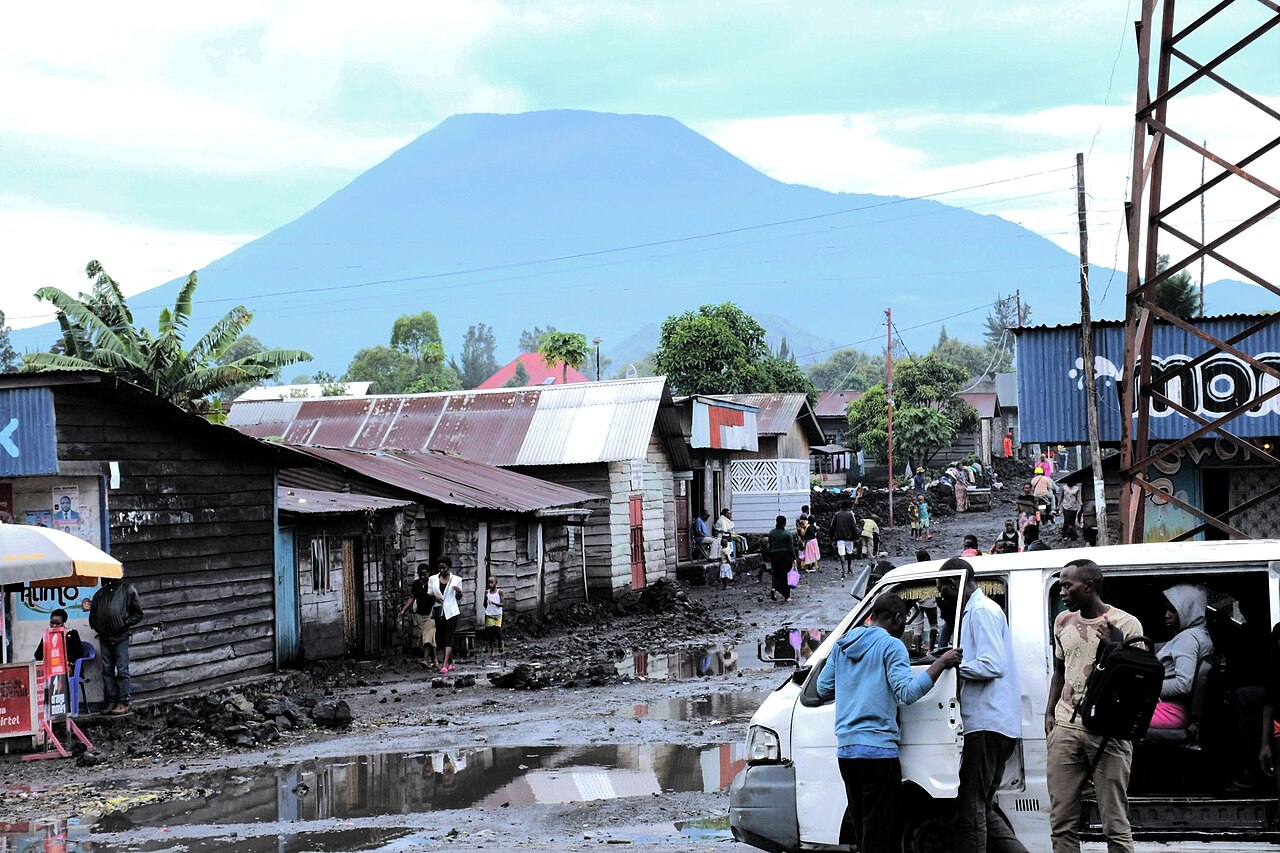
The Summit Crater and Its Lava Lake
Nyiragongo's summit crater measures approximately 1.2 kilometres across and hosted a lava lake through much of its documented history. The lake's presence has not been constant: the crater drained during flank eruptions and subsequently refilled over months and years, a cycle repeated across the volcano's recorded activity.
This behaviour distinguishes Nyiragongo from most East African volcanoes, which accumulate lava in solid edifices rather than maintaining an active lake near the surface. The condition has made Nyiragongo one of the most intensively studied volcanoes on the continent and a subject of sustained remote sensing and ground-based observation.
Flank Eruptions and the Proximity of Goma
Nyiragongo's most consequential events have originated along its flanks rather than at the summit. In 1977, flank eruptions sent lava flows descending the volcano's slopes. The 2002 eruption produced flows that reached Goma, a city immediately south of the volcano's base extending to the shore of Lake Kivu. A NASA satellite image from 2002 documented lava paths running against the city's urban fabric and toward the lake. In May 2021, flank flows again reached the outskirts of Goma.
The speed of flank lava propagation during these events differs markedly from the slow effusion typical of the summit lake, a distinction central to understanding the volcano's hazard character. The repeated relationship between eruptive episodes and Goma's urban geography has become a defining theme in volcanological literature on Nyiragongo.
Post-Eruption Monitoring and Crater Refilling
Following the May 2021 eruption, the summit crater underwent partial collapse, temporarily reducing or eliminating the lava lake. Sentinel-1 synthetic aperture radar data, documented by the Smithsonian Global Volcanism Program, tracked slow structural changes within the crater from June 2021 through at least March 2024, including small intra-crater flows. These observations showed gradual infilling over that interval, though the data do not indicate the crater returned to its pre-2021 condition.
The methodology applied between eruptions — combining satellite radar with ground observation — reflects the volcano's status as a priority surveillance target. Its position within the Virunga chain and its adjacency to Goma's large urban population make Nyiragongo one of the most consequential volcanoes in central Africa for both scientific research and humanitarian planning.