
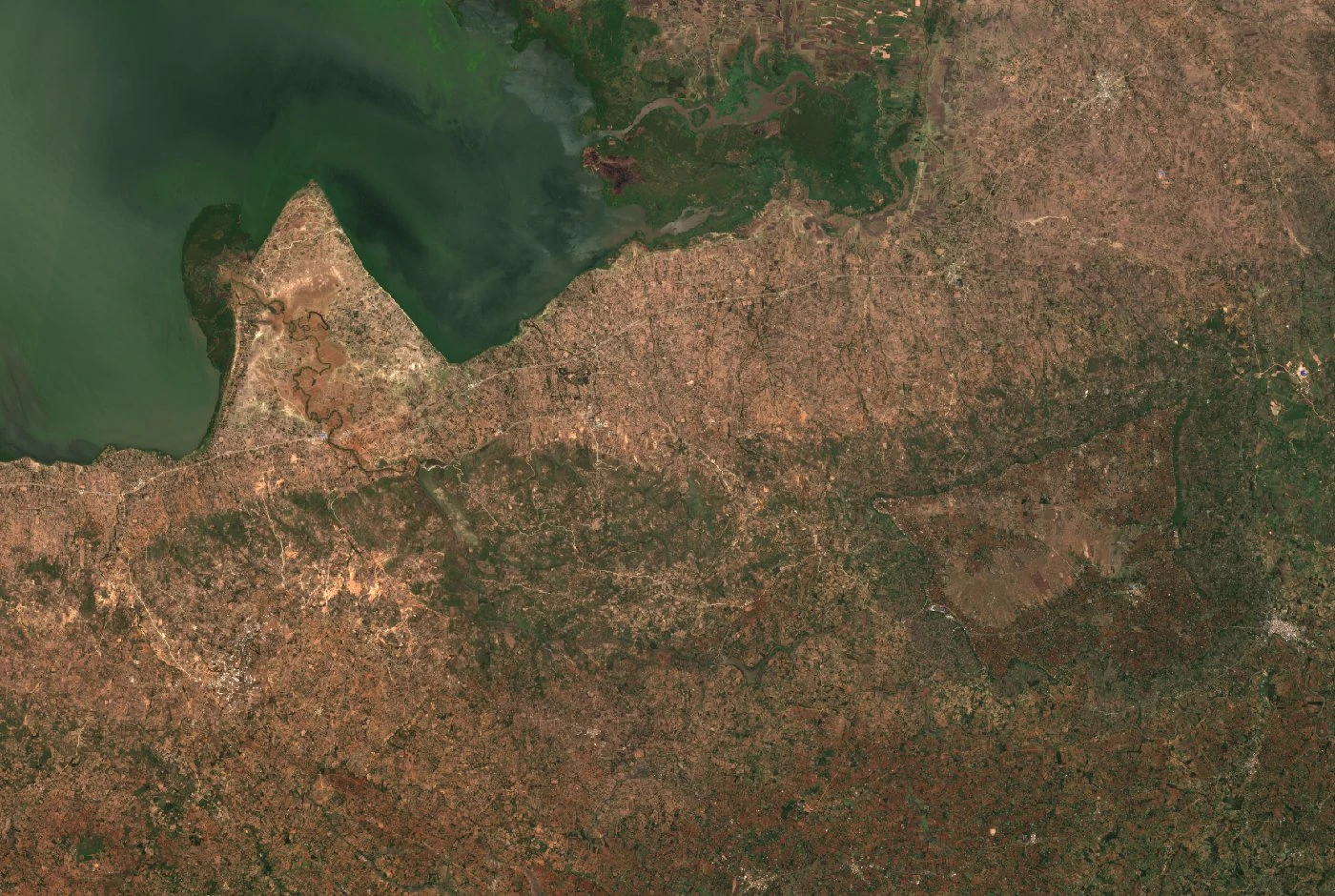
Landform and River Valleys
In their 1999 field report, Isaya Onjala and colleagues describe the Sondu Miriu cutting a steep-sided course through iron-rich deposits into weathered Precambrian granodiorite. The researchers followed the river at the edge of the Nyakach Hills and Nyabondo Plateau.
The satellite image from 28 August 2026 shows the shoreline on the left and the hills inland to the east. A study of Upper Nyakach published in 2016 described elevations from about 1,100 metres at the lake shore to around 1,800 metres on the plateau.
Miocene Sedimentary Record
In a 2026 study, Venanzio Munyaka and colleagues reported argon dates that place the sampled Nyakach Formation between about 15.36 and 13.99 million years ago. At Kadianga, west of Sondu, they recorded sandstone and conglomerate with layers of volcanic ash. Fossils of the Old World monkey Victoriapithecus macinnesi are known from the formation.
The researchers used ancient soils, microscopic plant traces and carbon isotopes to reconstruct a warm, seasonally wet landscape. Their evidence points to forest with some grassy openings. The deposits reflect a river system shaped by rifting and episodes of volcanism.
Archaeological layers at Wadh Lang’o
The 1999 excavations at Wadh Lang’o on the Sondu Miriu documented pottery of different kinds in successive layers. Some upper fragments bore rows of impressions made by rolling a knotted strip across the clay, a pattern the archaeologists compared with modern Luo pottery. They recorded Urewe and Kansyore wares farther down in the sequence.