
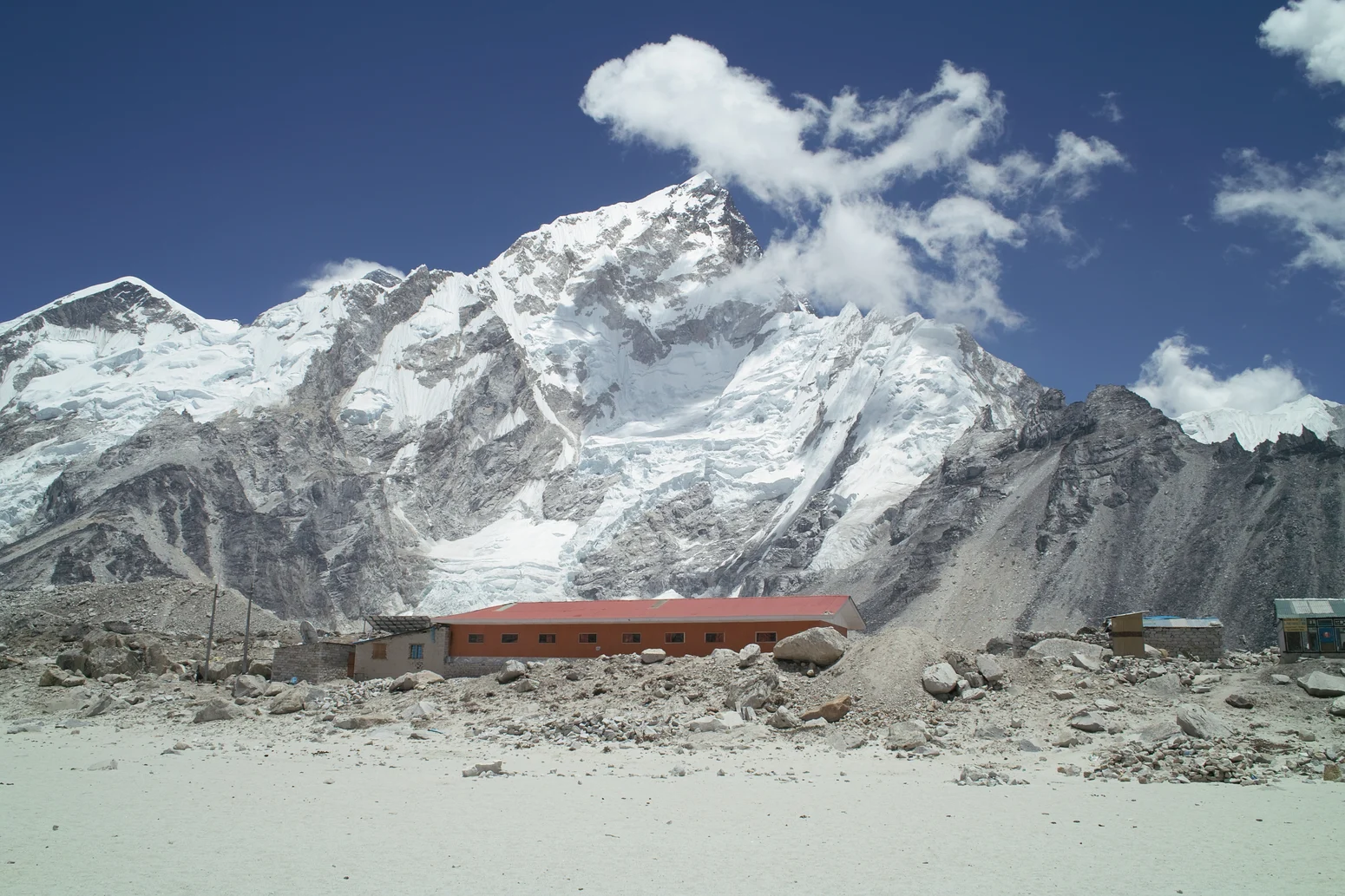
Position and Landform
Nuptse occupies the southwestern corner of one of the most concentrated ridge assemblies in the Himalaya. The peak's east-trending spine links it to Lhotse through a series of subsidiary summits, forming a continuous high wall above the Khumbu Glacier. The Nepal Department of Tourism records the main summit at 7,855 metres; the Himalayan Database has published a figure of 7,864 metres for the same point.
The massif's complexity becomes significant when interpreting expedition accounts. Nuptse Nup II, a northwest summit of the same massif recorded by the American Alpine Journal at 7,742 metres, is a distinct and lower point. Because route reports on Nuptse do not always specify which summit was the objective or the endpoint, readers must treat the identification of the specific point reached as essential context before comparing ascents or assessing difficulty.
First Ascent, 1961
The first ascent of Nuptse was made by a British expedition led by Joseph Walmsley. On 16 May 1961, Dennis Davis and Tashi Sherpa reached the main summit. Walmsley's account describes the two climbers alternating the lead through the summit couloir, cutting steps as they gained altitude, passing a false top before identifying the true summit, and arriving there at approximately 4:15 in the afternoon.
The following day, 17 May 1961, a second group from the same high camp completed the ascent. Chris Bonington, James Swallow, Les Brown, and Pemba reached the main summit, one day after Davis and Tashi Sherpa had made the first ascent. The sequence gave four additional climbers firsthand knowledge of the route in quick succession.
The South Face and the Question of Summits
In October 2017 a French team climbed a new line on the south face of the massif in alpine style. Their route ended not at the main summit but at Nuptse Nup II, the northwest subsidiary point at 7,742 metres. The American Alpine Journal account of this ascent documents the line as a significant technical achievement on its own terms while being explicit that the endpoint was Nuptse Nup II rather than the 7,855-metre top. The episode illustrates a recurring challenge in reading Nuptse's expedition record: the massif presents multiple high objectives on the same flanks, and route reports that omit the specific summit reached leave the difficulty and altitude of an ascent genuinely ambiguous.
Park Setting and Administrative Context
Nuptse lies within Sagarmatha National Park, the protected area established by Nepal to encompass the Khumbu peaks and their surrounding valleys. The park's formal overview lists Nuptse among the Khumbu peaks, treating it as one component of a shared high-altitude landscape that includes Everest and Lhotse and the ridge system connecting them.