
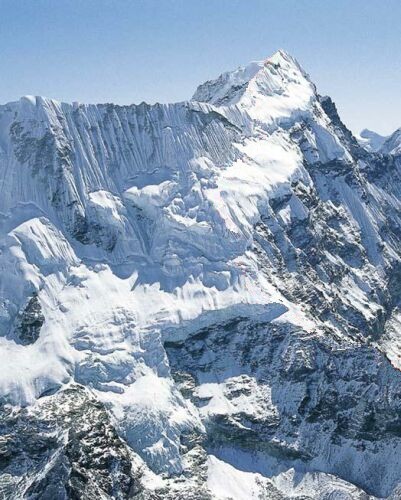
A new peak in the Khumbu catalogue
Nepal opened Numri to expeditions during the spring 2001 climbing season, as Elizabeth Hawley reported the following year. It was one of nine peaks opened that season, six of them in the Khumbu. The team that climbed it in 2002 reported an elevation of 6,677 m, the figure also used in Nepal’s 2025 tourism catalogue. The Himalayan Database gives 6,635 m in its June 2026 peak list, where Numri is coded NUMR in the Khumbu and Numbur is coded NUMB in Rolwaling.
The west face in 2002
The first documented ascent of Numri took place on 7 November 2002, via the west face, as recorded by Hawley in the American Alpine Journal (2003). Olaf Rieck led the seven-member German expedition. He, Carsten Schmidt and Lydia Schubert reached the summit.
The team's base camp was established on the Imja Glacier south of Island Peak at an elevation of 5,140 m. Their second and higher camp was a snow cave at 6,185 m. From there, the three climbed the west face to the summit.
Imja Glacier and Imja Tsho
Imja Tsho is a glacial lake below Numri in the Imja valley. A labelled ground photograph taken in October 2010 by Sharad Joshi identifies Numri at the left of the lake panorama. In September 2012, Somos-Valenzuela, McKinney, Rounce, and Byers conducted a sonar survey of Imja Tsho reported in The Cryosphere (2014), estimating a maximum depth of 116.3 ± 5.2 m. An earlier 2002 survey reported 90.5 m. The 2014 study also noted that the lake's expansion during the study period was concentrated principally at the glacier-lake contact on its eastern end.