
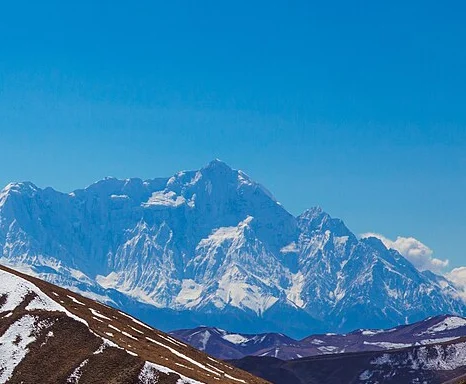
Summit Elevation and the Nilgiri Massif
The elevation of 7,061 m is the figure recognised by Nepal's Department of Tourism and carried in the Himalayan Database; an older estimate of 7,031 m circulated during and after the 1962 expedition but should not be treated as the current accepted value. Nilgiri North, Central, and South form a compact chain within the Annapurna Himal, and care is needed to distinguish them in expedition accounts where "Nilgiri" alone is sometimes used loosely. The northern peak's position as the highest of the three has made it the primary mountaineering objective, while its neighbours have attracted separate ascent histories of their own.
The 1962 First Ascent
On 19 October 1962, Lionel Terray, Wangdi Sherpa, and the brothers Holger, Peter, and Paul van Lookeren Campagne reached the summit of Nilgiri North — the first recorded ascent of the peak. This date appears in both the Himalayan Database and the Himalayan Journal expedition chronology table. The climbing party's route followed the north face and west ridge, a line that required the team to navigate serious high-altitude terrain before topping out on the summit.
Lionel Terray, the celebrated French alpinist, brought considerable Himalayan and Alpine experience to the team. The van Lookeren Campagne brothers represented the core Dutch membership of the expedition, and Wangdi Sherpa was an integral member of the summit party. The expedition account renders Wangdi's name as "Wongdhi" in some passages; the Himalayan Database rendering Wangdi is used here for consistency.
The Netherlands Himalayan Expedition and Its Scientific Mission
The 1962 venture was formally the Netherlands Himalayan Expedition, led by C. G. Egeler, and it was distinctive in pairing systematic geological fieldwork with its mountaineering objectives. This dual mandate shaped where the expedition directed its energy in the field: the team was not simply moving toward a single high point but conducting geographically targeted survey work across the surrounding terrain. Egeler's scientific programme added a layer of documentation to the expedition's legacy that extended beyond the first-ascent record alone.
The 1962 expedition combined climbing with geological fieldwork in the Annapurna Himal. The Himalayan Journal report documents both the ascent and geological observations from the area, and it remains the primary narrative source for both dimensions of the expedition's work.
Position in the Himalayan Record
Nilgiri North is identified in official records by the Himalayan Database peak identifier NILN and appears in Nepal's government registry of Himalayan summits as one of the recognised peaks of the Annapurna Himal. The peak's first-ascent story, anchored to a precise date and a named five-person team, gives it a well-documented place in the broader archive of mid-twentieth-century Himalayan exploration.