
Valley Junction and the Surrounding Landscape
The settlement occupies a position where Vistasvagge, Ladtjovagge, and the valleys feeding the Kalixälven headwater lakes converge, with Lake Paittasjärvi extending to the east. Gällivare municipal planning documents identify the place — recorded in earlier chapters as Nikkaloukta — explicitly as a starting and ending point for Kebnekaise climbs and Kungsleden walks, the long-distance trail lying farther to the west. Nikkaluokta falls between the territories of the Laevas and Girjas reindeer-herding communities, whose seasonal migration routes have long shaped the land use of this part of Norrbotten.
Settlement History and the Sarri and Haugli Families
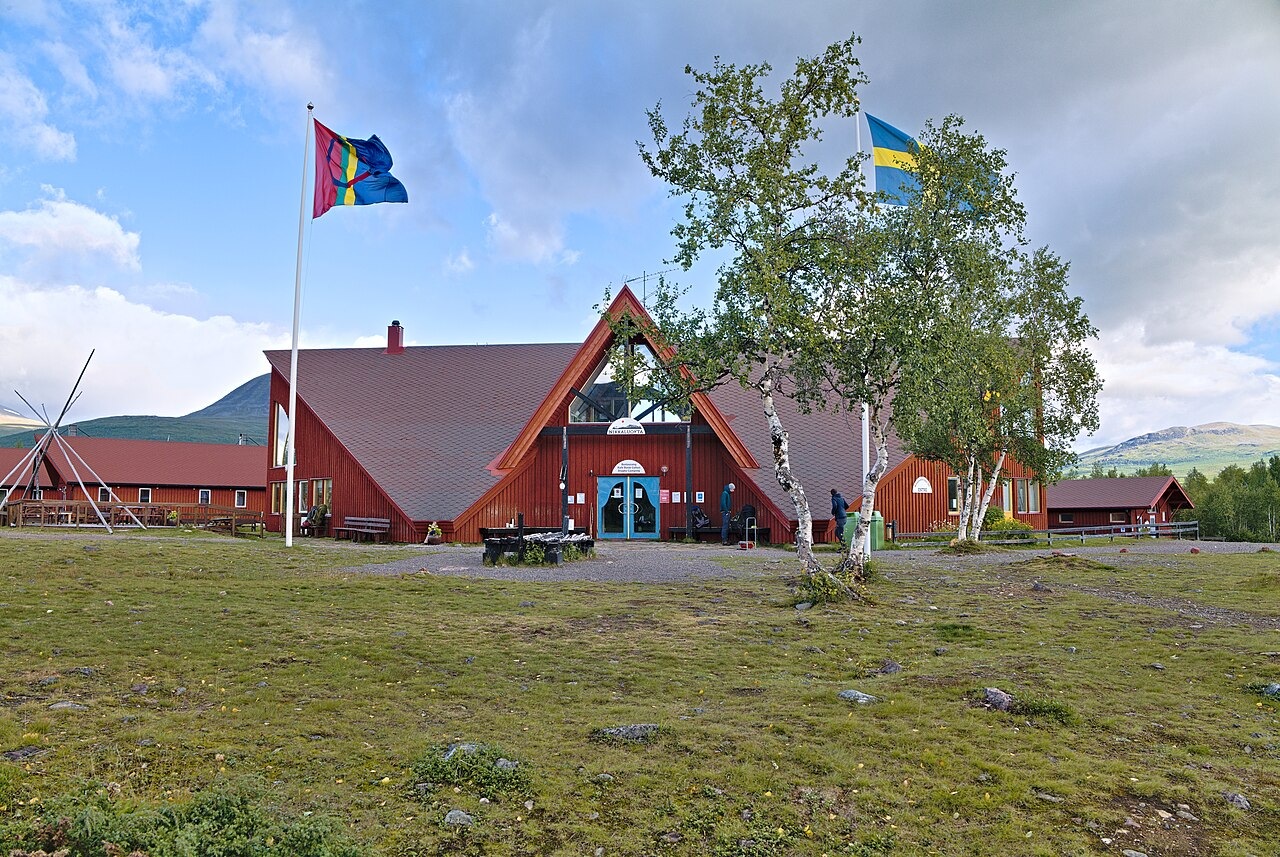
Turf-covered dwellings appeared in the area in the early twentieth century, built by Sámi families along existing migration corridors; an archive of images made by Israel Ruong in 1936 documents three distinct local building forms from that period. Nils Olsson Sarri and Maria Sarri were among the families who established a permanent presence here, fishing, hunting, and eventually offering food and accommodation to visitors in their own home. A second family, the Hauglis, became part of the same tradition of hospitality, and the guest facilities they developed led to the mountain visitor centre completed in 1991 from a project by architect Hans Tirsén of FFNS — the building flying both the Sámi and Swedish flags that appears in Leonhard Lenz's 2022 photograph.
The Chapel on the Hill
Separate from the visitor centre, a red chapel designed by Cyrillus Johansson stands on a hill above the settlement and was consecrated on 16 August 1942. The building was a gift to the community and parish from De Lappländska Fjällkarlarnas klubb, while the Swedish Tourist Association contributed the altar ornament and local residents donated altar linens. These multiple acts of gift-giving reflect the layered relationships between the parish, alpine associations, and the people living at this remote northern settlement.