
Morphology and structure
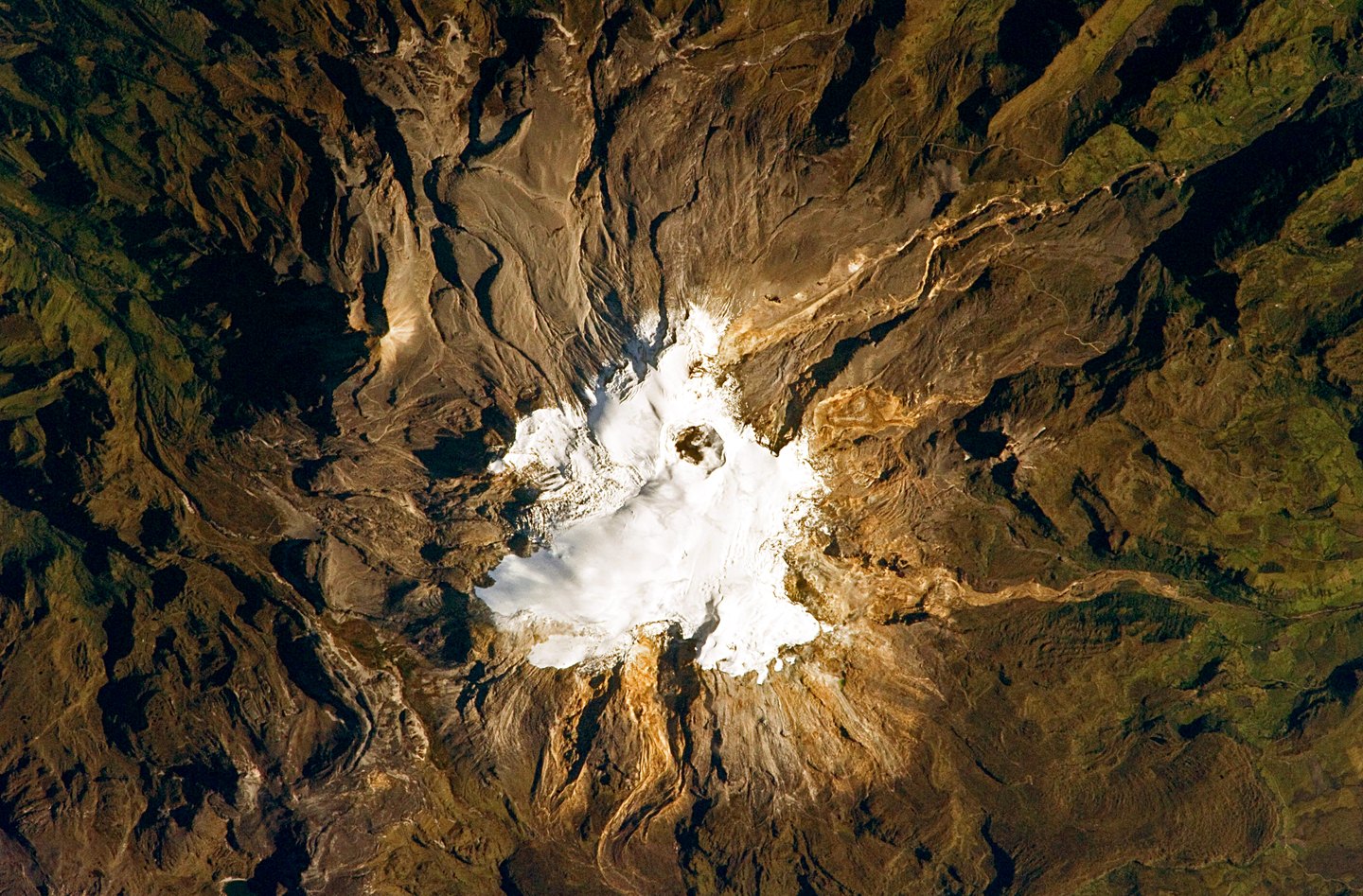
Nevado del Ruiz is a multi-stage volcanic complex whose central feature is the Arenas crater, flanked by subsidiary cones known as La Olleta and La Piraña. This layered architecture reflects a prolonged history of construction and destruction: the SGC places the onset of volcanic activity at approximately 1.8 million years ago, making Ruiz one of the volcanic systems with the most extensive record in the Colombian Andean chain.
A persistent ice cap overlies the volcanic edifice; its extent is subject to ongoing scientific monitoring. The SGC reproduces in its reports glacial-cover data from the Institute of Hydrology, Meteorology and Environmental Studies (IDEAM); the 2023 report attributes to that source a figure of 7.68 km² of glacial cover. The interaction between the ice and hot volcanic fluids is the volcano's most consequential geomorphological characteristic.
Eruptive history and lahars
The historical record of Ruiz is punctuated by lahar episodes — flows of volcanic debris and mud — generated when eruptive heat melts the ice and mixes the water with pyroclastic material. The SGC documents lahars in 1595 and 1845 as precedents that traced flow paths along the gullies descending from the volcano toward the surrounding valleys.
The 1985 eruption produced the most thoroughly documented lahar in the volcano's recent history: the interaction between activity at the Arenas crater and the glacial ice cap generated flows that descended through several drainage channels. This event made Nevado del Ruiz a central case study in Latin American volcanology and prompted the development of volcanic monitoring networks maintained by the SGC to this day.
Contemporary monitoring
The SGC maintains permanent surveillance of Nevado del Ruiz using seismic, geochemical and surface-deformation sensors. Periodic volcanic activity reports for the northern segment synthesize the parameters observed at the Arenas crater and the subsidiary cones, constituting the principal instrument of scientific communication about the volcano's status.
The coexistence of the glacier with an active volcanic system makes Ruiz a natural laboratory for studying the interaction between the cryosphere and volcanism. The documented reduction in ice cover over the twentieth century and into the twenty-first adds a climatic variable to an already complex system, an issue that the SGC and IDEAM address in a coordinated manner in their joint publications.
Regional context
Nevado del Ruiz is part of the Los Nevados Natural National Park alongside other snow-capped volcanoes of the Cordillera Central. Its position on the departmental boundary between Caldas and Tolima gives it significance for two distinct river catchments whose waters ultimately drain into the Magdalena system. The páramo and glacial landscapes surrounding the volcano represent high-mountain ecosystems with a biodiversity characteristic of Andean altitudinal belts.