
A Ridge Shaped by Two Volcanic Episodes
In 2023, Anaïs Rusquet and colleagues used potassium–argon dates and seafloor topography to reconstruct two stages of volcanic growth on Mohéli. An early volcanic structure grew from before 3.8 million years ago to about 3 million years ago. Part of it sank. Around 2 million years ago, renewed volcanic activity began building a ridge oriented in a different direction.
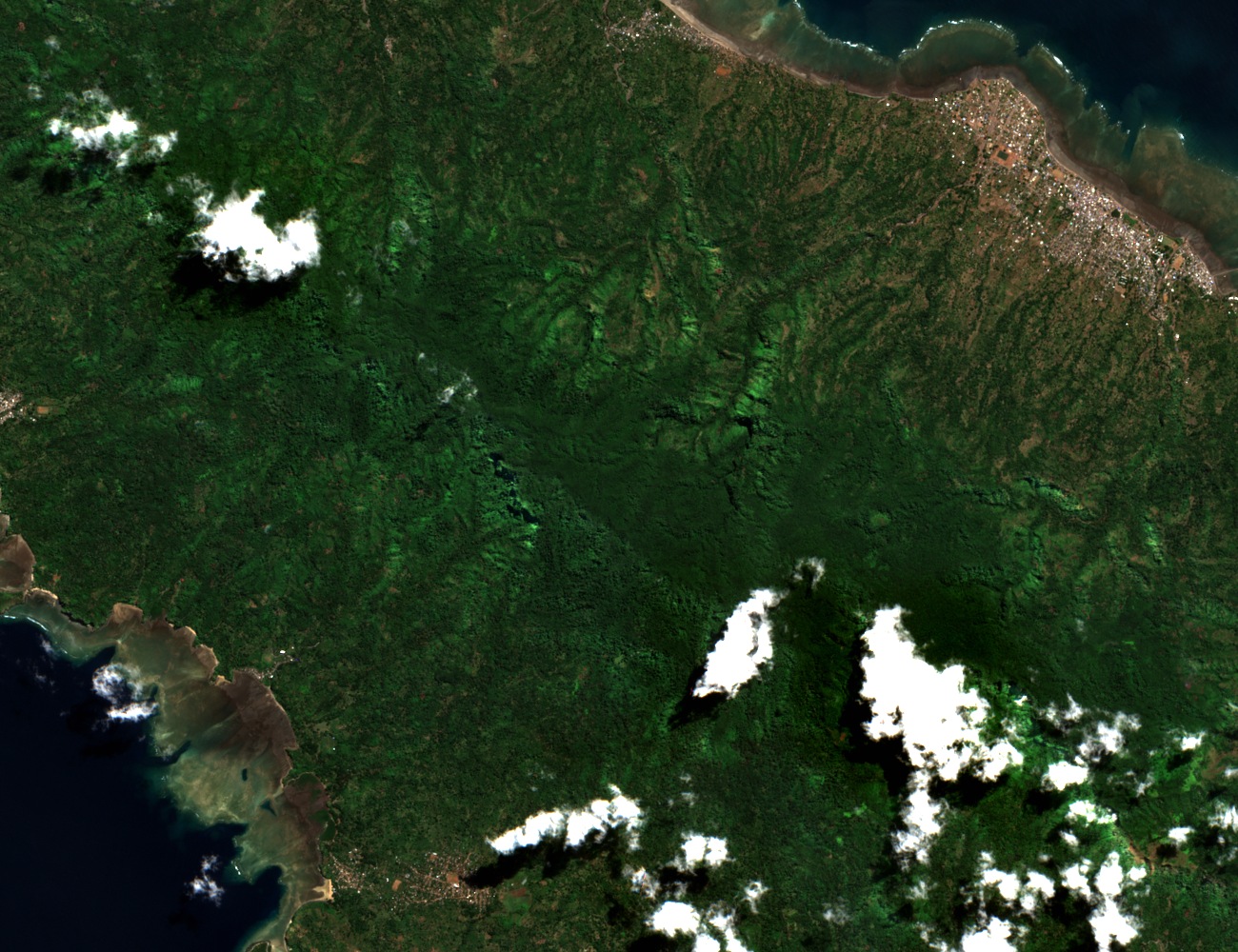
The wooded ridge now stays above 700 metres for about eight kilometres. Catchments on its slopes drain to Fomboni, Nioumachoua and Miringoni. The 2018 Key Biodiversity Areas assessment describes low cloud forest on exposed ridges, with taller forest at sheltered sites. The satellite image shows the ridge in the middle and Fomboni toward the upper right.
A Call Heard at Dusk
In September 1996, researchers counting forest birds from listening stations heard an unfamiliar call after sunset. René-Marie Lafontaine and Nathalie Moulaert formally described the Mohéli scops owl, Otus moheliensis, in 1998, using its call and plumage to distinguish it. The specimen designated as the type was collected at 620 metres in the Mlédjélé forest in October 1996.
The forest is also home to Livingstone’s fruit bat, Pteropus livingstonii, a species found on Mohéli and Anjouan. Regular surveys of known roosts on Mohéli began in 2019. A study published in 2024 reported that the counts varied with the season.
Biosphere Reserve and Tentative World Heritage Listing
In 2020, UNESCO designated Mwali a biosphere reserve that covers Mohéli’s land and marine territory. Its core areas include forest and marine habitats.
On 19 March 2026, the Comoros submitted the terrestrial ecosystem and cultural landscape of Mohéli to the World Heritage Tentative List. The submission includes the Mzé Koukoulé ridge forest and Dziani Boudouni, a crater lake elsewhere on the island.