
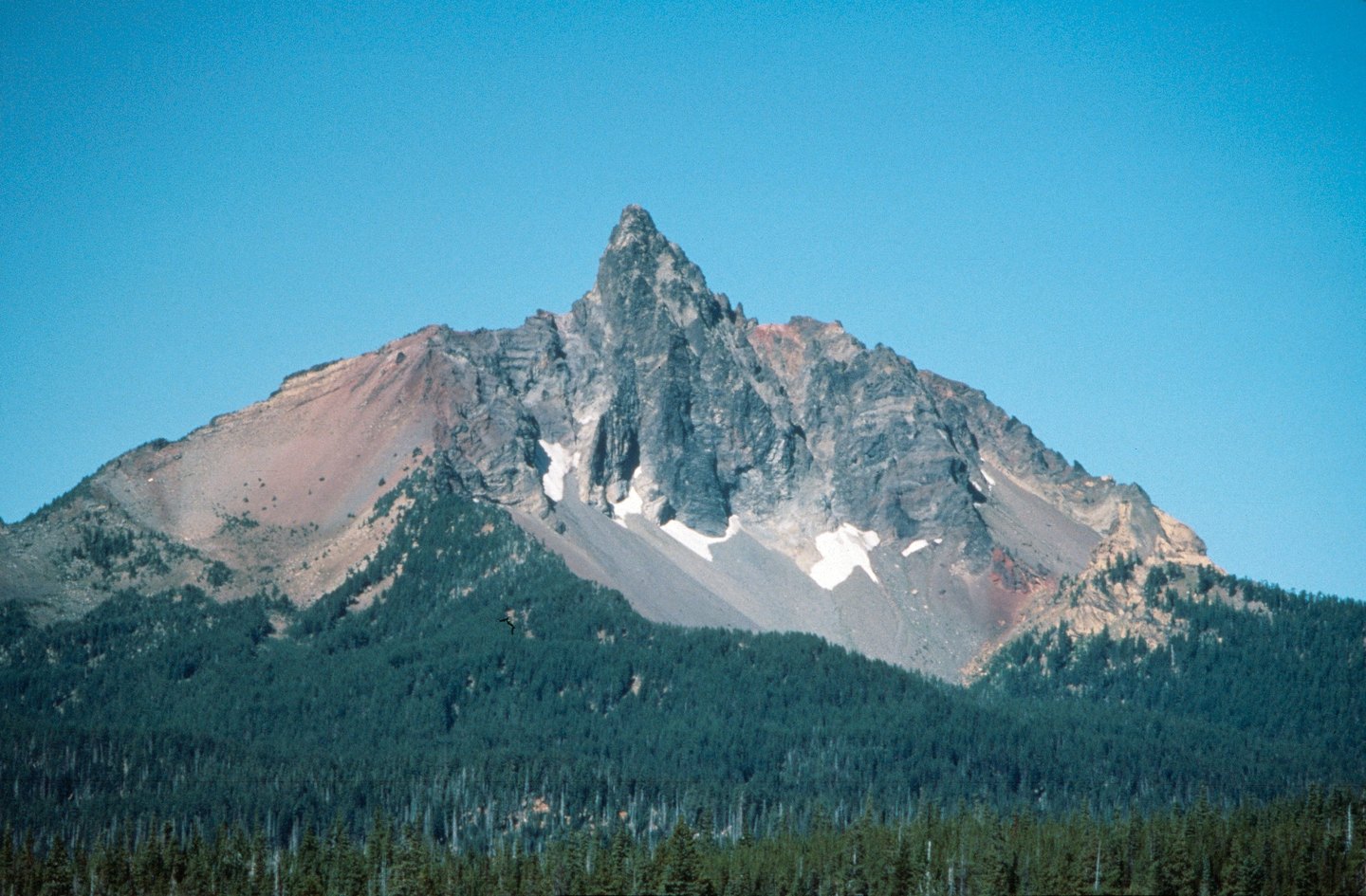
A Plug Above the Shield
Mount Washington's steep summit is a volcanic plug, rock that solidified inside the former eruptive conduit and was left standing when the surrounding shield eroded away. The original edifice was built from basaltic-andesite eruptions. Repeated glaciation progressively removed the outer flanks, isolating the resistant central column at an elevation of 2,376 meters. This erosional history gives the peak its characteristic needle-like profile.
Spatter Cones on the Northeast Flank
A row of spatter cones on the northeast flank follows a regional fissure. The Global Volcanism Program connects these features to the Blue Lake Crater event on compositional grounds, and the USGS documents an aligned cone row alongside nearby tephra deposits in the same corridor. These cones represent a younger episode of volcanic activity separate from the older shield summit.
Surrounding Volcanic Terrain
Mount Washington sits within a wider field of discrete volcanic landforms, each with its own origin. To the northeast, the Smithsonian Institution's Global Volcanism Program identifies Cache Mountain cinder cones. To the northwest lie Hayrick Butte, a tuya formed by eruption beneath glacial ice, and Hoodoo Butte. Each feature records different eruptive conditions across this part of the central Cascades.