
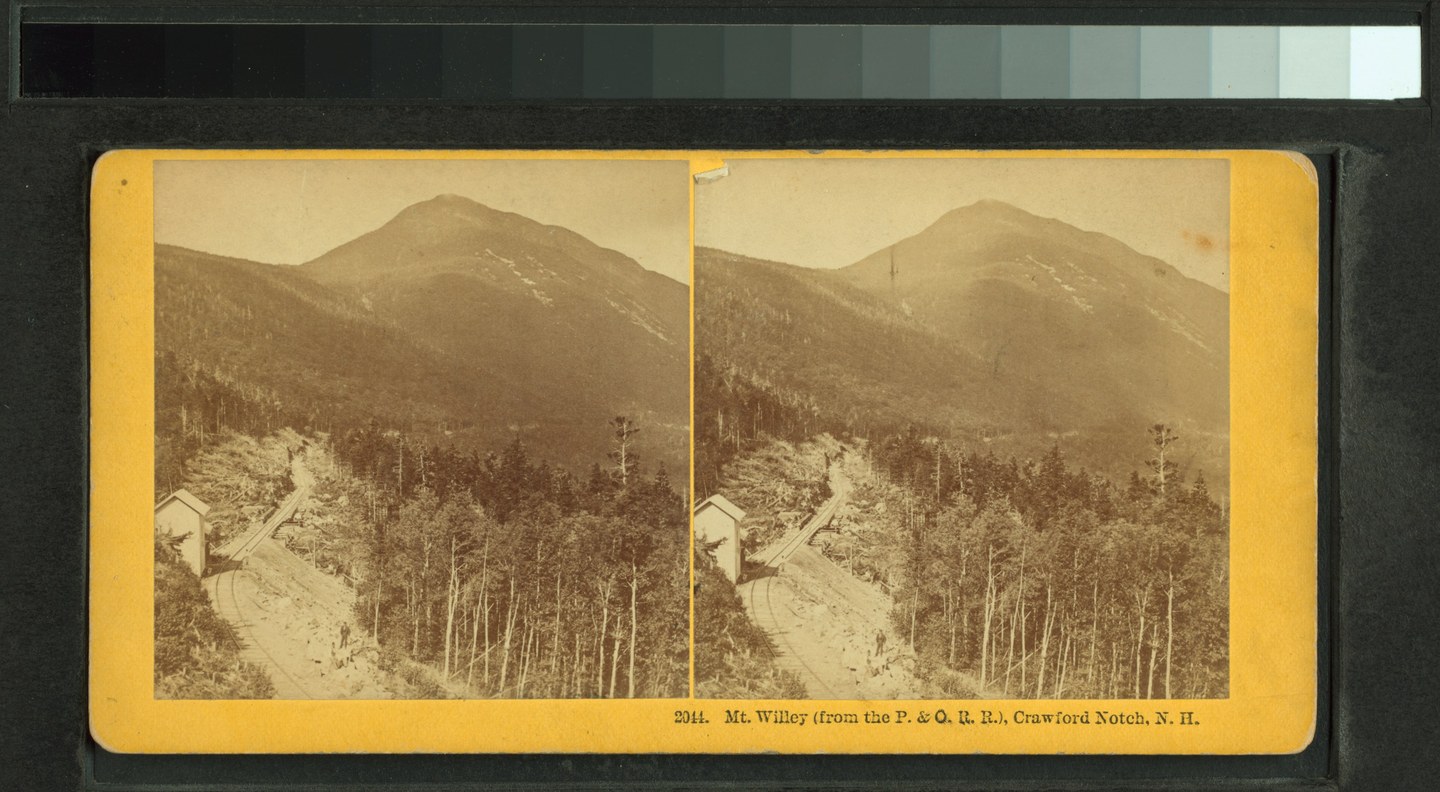
A Summit on the Willey Range
Mount Willey's 1,306-meter crest belongs to the Willey Range, the ridge that forms the western wall of Crawford Notch. The Presidential Range peaks rise on the opposite side of the notch, making the two groups distinct ridgelines rather than parts of a single massif. The Appalachian Mountain Club includes Mount Willey on its White Mountain Four Thousand Footers list.
The Late-August 1826 Debris Avalanche
In late August 1826, a severe rainstorm loosened earth, rocks, and vegetation on the flank of Mount Willey. The sliding mass divided above the family house, passing on either side and leaving the structure standing. Nine people — the members of the Willey household and two hired men — died in the disaster.
Geological field work has identified surviving natural levees from the event, landform evidence consistent with a debris avalanche rather than a simple rockfall or the glacial processes that shaped the broader notch.
Art and Literature
Nathaniel Hawthorne drew on the Willey disaster for his story "The Ambitious Guest," treating the family's fate as a parable of human ambition against an indifferent natural force. Thomas Cole painted Crawford Notch in 1839, a canvas now held by the National Gallery of Art. The National Gallery is explicit that Cole's composition depicts a separate later scene at the notch, showing the Notch House rather than any visual record of the disaster or the Willey family home. The painting nonetheless entered the cultural memory of the event, connecting American landscape painting to the story of the slide.