
Dual Name and Indigenous Language
The name kunanyi (pronounced /kuːˈnɑːnjiː/) belongs to palawa kani, the language reconstruction project drawing on surviving records of Tasmanian Aboriginal languages. When the Tasmanian government announced its dual naming policy in 2013, kunanyi / Mount Wellington became one of the first geographic features to receive this formal recognition, placing the palawa kani name alongside its colonial-era designation in official records and on signage.
The dual naming reflects a broader effort to restore visibility to Tasmanian Aboriginal place knowledge. The mountain's presence as an immediate and constant backdrop to Hobart — visible from across the city throughout all seasons — gives the recognised name a cultural weight that extends well beyond administrative geography.
Terrain and Summit Conditions
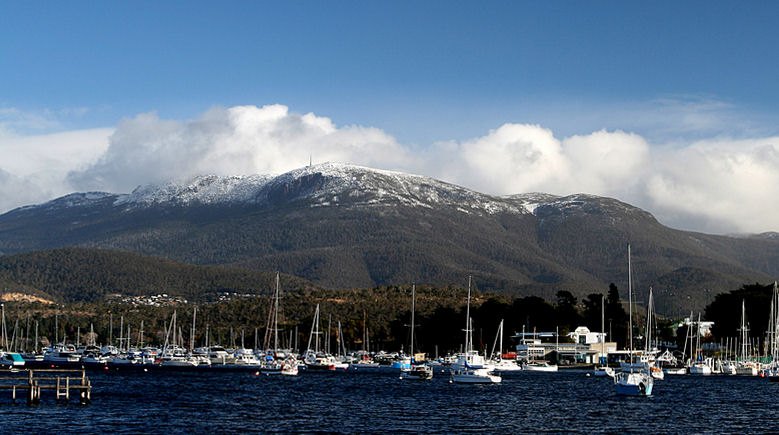
Despite an elevation modest by global standards, kunanyi / Mount Wellington exhibits a range of conditions across its vertical relief that sets it apart from most urban mountain settings. The lower slopes are thickly forested and laced with walking tracks and fire trails. Higher on the mountain, the landscape opens and becomes more exposed, and snow can be present at the summit even in summer — an occurrence that underscores the mountain's capacity to generate its own microclimate independent of conditions in the city below.
An enclosed lookout near the summit provides views across Hobart and eastward toward the sea. A sealed narrow road — Pinnacle Road — runs approximately 22 kilometres (14 mi) from the Hobart central business district to the summit, a route that has its own history as a civic infrastructure project and feature of Tasmanian life documented in historical records including the Tasmanian Year Book.
Mountain and City
The relationship between kunanyi / Mount Wellington and Hobart is unusually intimate for a capital city. The summit is visible from most parts of the urban area, and its shifting appearance — cloud-covered or clear, snowcapped or bare — functions as an informal weather indicator for residents. The mountain's presence within Wellington Park reserve, a protected area, has maintained the forested slopes immediately adjacent to the city in a relatively undeveloped state, reinforcing the sense of proximity between urban and alpine environments.
The Pinnacle Road and the network of walking tracks on the lower slopes have made the mountain continuously accessible to Hobart residents across generations, embedding it in the daily life and historical memory of Tasmania's capital in ways that go beyond the typical relationship between a city and a nearby natural landmark.