
Terrain and vegetation zones
The southeastern slopes of the range descend into the Isuani Basin, where narrow valleys and forest lie between areas of open high ground and the upper crest. In many of the sampled grasslands above 2,800 m in the Isuani Basin, the 2022 field study records stands dominated by the fern Gleichenia vulcanica. Cloud forest fringing those same Isuani grasslands often forms stands dominated by the conifer Dacrycarpus compactus.
Shallow, peaty alpine tarns occur in this upper zone across the Owen Stanley Range. James Croft's 1980 study records the aquatic quillwort Isoetes neoguineensis from such tarns in the range, with specimens Croft LAE 61775 and Craven 3070 from the Victoria area among the documented collections.
The 1974 botanical expedition
A helicopter-assisted botanical expedition in 1974, led by Jim Croft of Lae with field assistants Yakas Lelean, Artis Vinas and Greg Larivita, worked for several days from the Isuani grassland, a terraced basin at about 2,700 m south of Mount Victoria, before reaching the main summit on 13 July. Lyn Craven joined the party during the Victoria stage and made his own collections alongside the team. A 1975 report lists 138 collection numbers from Isuani and 140 from Mount Victoria for Croft's party. One specimen collected by Croft and Larivita on the southeast slope on 7 July 1974, numbered LAE 61684, was later designated the type specimen of the nightshade Solanum invictum in Anthony Bean's 2016 paper.
The smooth-eared skink of the upper grassland
The 2022 study by Alex Slavenko and colleagues describes the skink Ornithuroscincus pterophilus from the Mount Victoria area. The type specimen is a female collected by Allen Allison on 15 August 2015 at 2,813 m in the Isuani grassland. The specific epithet means fern-loving, reflecting the tendency of individuals to be found among tree-fern fronds in that grassland. Other documented localities for the species include a crossing on the Kokoda Track and the nearby site of Myola.
The range from above
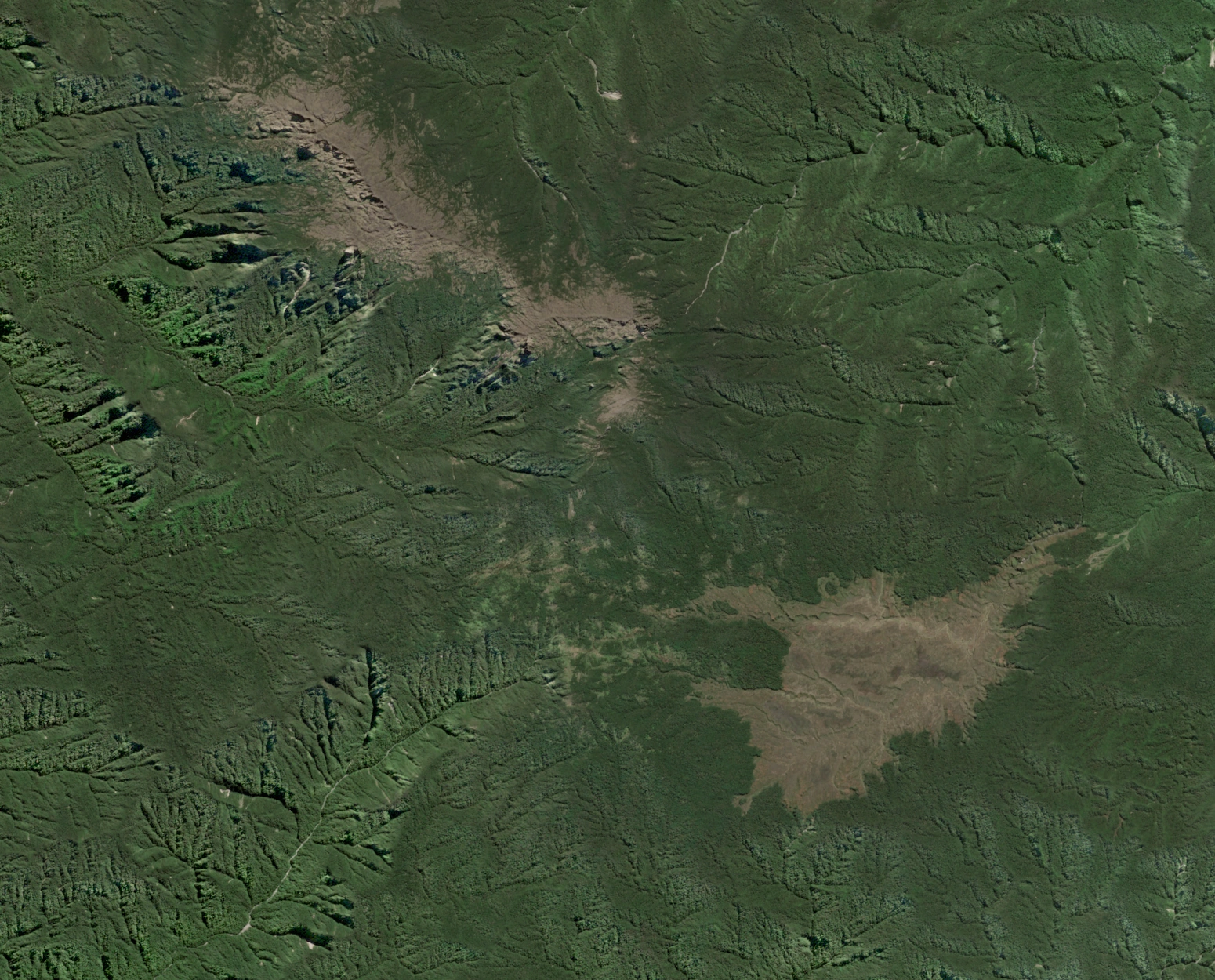
A natural-colour Sentinel-2C image acquired on 16 June 2026 shows the bare and open patches of the upper crest descending from the upper left, with the main Mount Victoria high point in the upper left third of the frame. The open Isuani Basin lies at the lower right, its terraced form identifiable against 30 m surface elevation data. The forested slopes between the two, divided by narrow valleys, fill the intervening ground. Contains modified Copernicus Sentinel data 2026.