
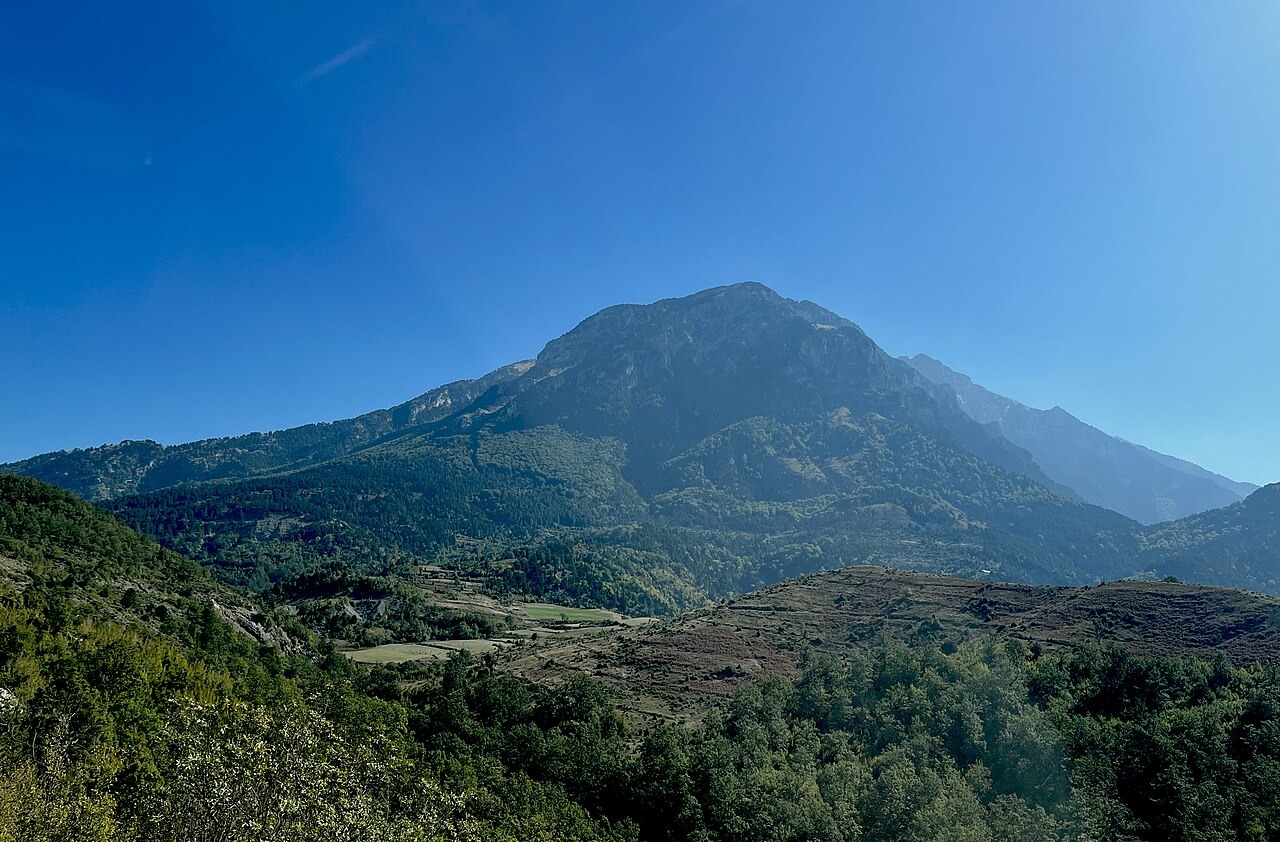
Mountain Landscape and National Park
Tomorr extends as a long, unbroken ridge above the agricultural lowlands of Berat, a silhouette visible from the valley floor to the west. The massif holds national park status, with the protected area spanning its full elevational range from lower forest through subalpine grassland to the rocky high ground at Çuka e Partizanit. Forest cover shifts with altitude, from mixed montane woodland at lower elevations to open grassland near the summit zone.
Glacial Landforms and Karst Springs
The northern and northeastern sectors of Tomorr carry evidence of past glaciation, where cirques and two glacial thresholds remain visible in the high terrain. Karst springs emerge at the western foot of the massif, among them the Tomorr and Bogovë springs, which drain through limestone bedrock into the valleys below.
Bektashi Pilgrimage and Mountain Folklore
Each year between 20 and 25 August, Bektashi believers gather on Tomorr for the feast of Abaz Ali, honouring Abbas ibn Ali. The Albanian public broadcaster reported in 2024 that the five-day observance drew large crowds to the mountain, with a tekke and shrine on the mountain serving as places of pilgrimage. The national tourism authority also documents a local personification of Tomorr as Baba Tomorri, a folkloric figure in which the massif is understood as a presiding spirit of the landscape.