
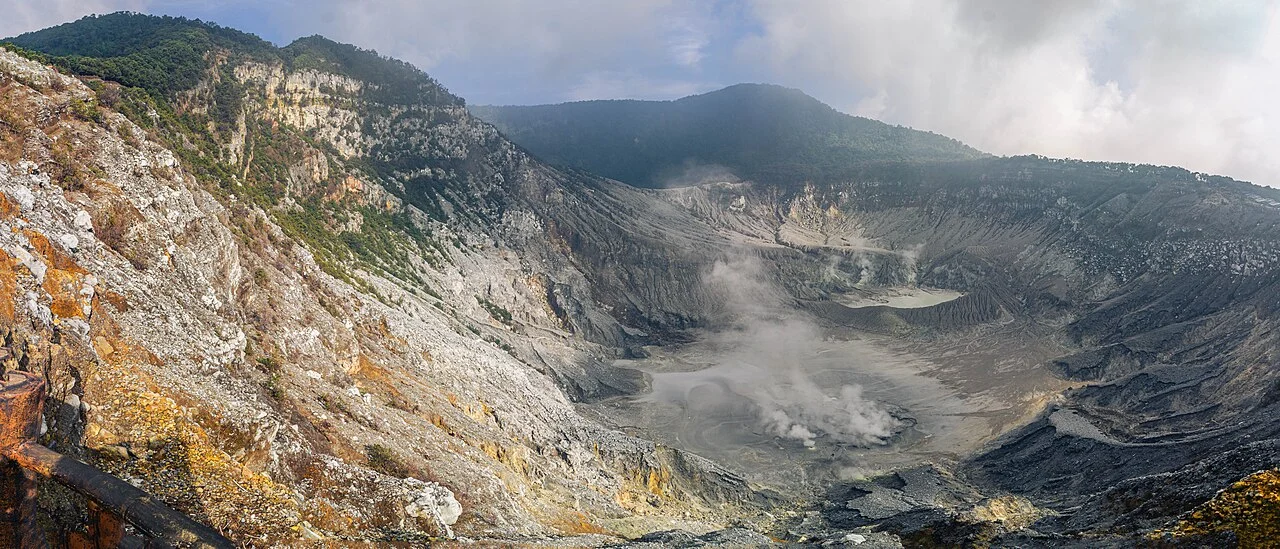
Younger Cone Inside the Sunda Caldera
The Sunda caldera forms the larger architectural frame, an elliptical collapse structure whose dimensions the GVP records at approximately six kilometres by eight kilometres. Inside that older basin, the Tangkuban Parahu edifice grew as a separate constructional event, producing the broad, low-angle form visible today. The summit depression is not a single feature but a compound zone: Ratu, Upas, and Domas are individually named craters, each occupying a distinct position within the oval depression, and their separate identities are significant to both volcanological monitoring and to the landscape's visual character at close range.
The three documented craters within the summit complex — Ratu, Upas, and Domas — occupy a depression roughly one by one and a half kilometres across. The older Sunda caldera rim is largely covered by younger deposits from the edifice built within it, so the two generational structures read at different scales across the terrain.
Ratu Crater and the 2019 Phreatic Events
The GVP and its associated bulletin record documented phreatic activity at Ratu crater in 2019, with observations contributed by Indonesia's Centre for Volcanology and Geological Hazard Mitigation, known by its Indonesian acronym PVMBG. Phreatic eruptions are steam-driven explosions that occur when groundwater or surface water contacts hot rock or volcanic gases at depth; they are distinct from magmatic eruptions in that they do not necessarily involve the eruption of fresh lava or magma, but they can expel ash, steam, and fragmented country rock with considerable force. The 2019 events at Ratu produced measurable ash and steam columns documented in dated PVMBG field reports, making them among the more precisely recorded episodes in the volcano's modern observational history.
Ratu crater was the focus of GVP bulletins covering July through September 2019, a period of documented phreatic unrest at the summit. Upas and Domas craters form part of the same summit complex but were not the subject of those reports; each crater carries its own morphology and thermal character, and the monitoring record is spatially specific to the crater under observation.
Sangkuriang and the Sundanese Mythological Tradition
The name's evocation of an overturned boat is not merely descriptive geography — it is the closing image of one of the most widely circulated narratives in Sundanese oral tradition. Scholarly work published in the journal Patanjala, which documents Sundanese cultural and mythological traditions, identifies Sangkuriang and Dayang Sumbi as the central figures in a legend that ends with the formation of the volcano. These are figures of myth, and the story represents a Sundanese cultural framework for understanding the landscape rather than a historical or geological account. The Patanjala sources treat the narrative as mythology, and that designation should be preserved: the legend illuminates how Sundanese communities have long oriented themselves to a conspicuous volcanic landmark, not how the mountain was formed.
The dual naming — Tangkuban Parahu alongside the alternate spelling Tangkuban Perahu — reflects variation found across authoritative sources including the GVP record, and both forms refer to the same 2,084-metre summit. The name connects to the Sundanese Sangkuriang tradition, which provides the cultural framework for the upturned-boat imagery associated with the volcano's profile.
Volcanic Context in the Java Arc
Tangkuban Parahu belongs to the Sunda Volcanic Arc, the chain of volcanoes produced by subduction along the Java Trench. The Sunda caldera's age of roughly 190,000 years, as reported by the GVP, situates the volcano's growth within a relatively recent episode of regional volcanism. The GVP catalogue number 263090 identifies the system within the global database, and the programme's bulletin series provides the primary modern record of its eruptive behaviour.
The volcano presents a broad base and a low summit elevation relative to its width, with a nested crater depression approximately one by one and a half kilometres across. At 2,084 metres the summit stands below the highest peaks of the West Java arc, but the documented recurrence of phreatic unrest at Ratu crater and the structural complexity of the crater field give the mountain a scientific profile that its modest elevation does not immediately suggest.