
Makran Arc Origins and Zircon Ages
Taftan's andesitic lavas reflect arc petrogenesis driven by slab-derived fluids, described in a 2014 study by Pang and colleagues. Zircon crystals from the edifice returned ages of approximately 3.4 to 3.2 million years, with one sample at 0.84 ± 0.06 million years. The Smithsonian lists eruption reports from 1902 and 1993 as uncertain; a 1993 lava observation has been interpreted as potentially molten sulfur.
Fumarolic Field on the Southeast Cone
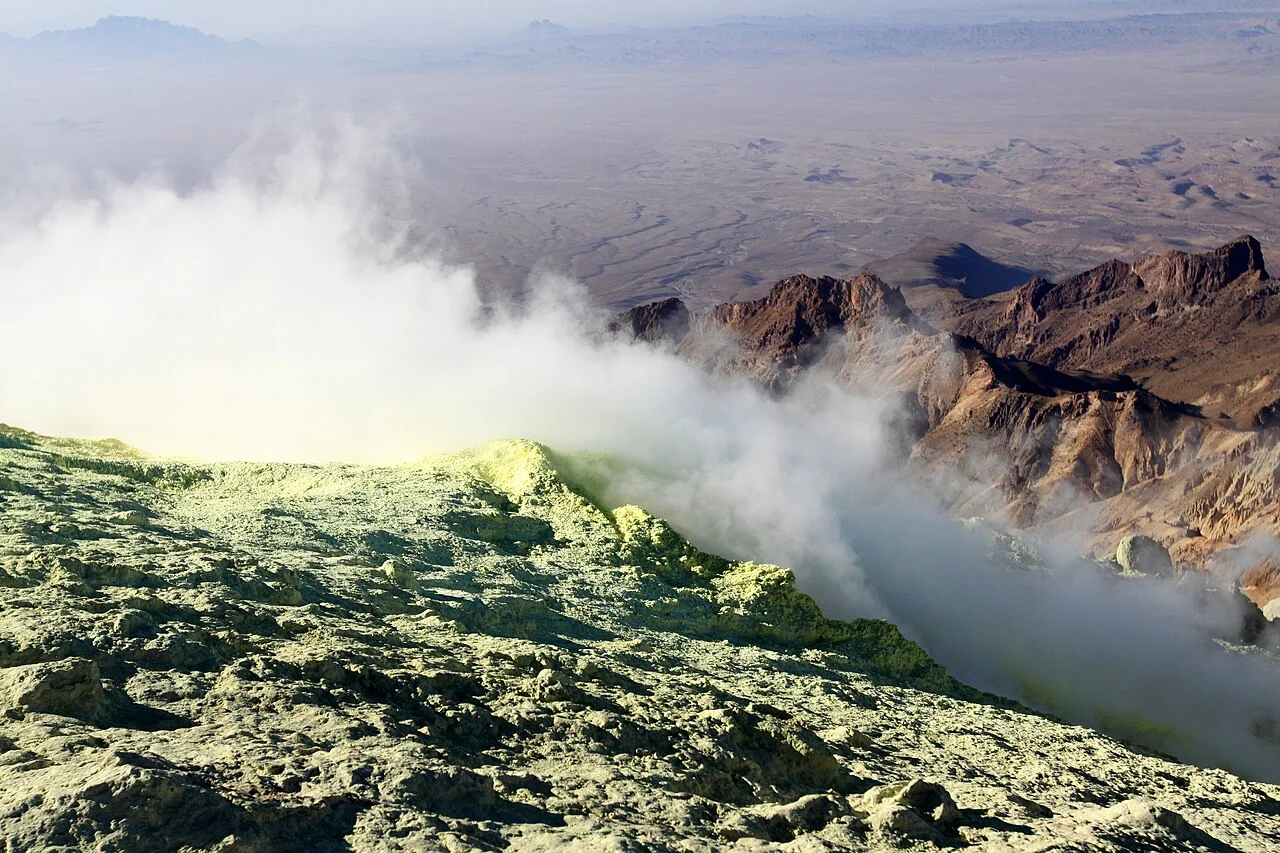
In October 2003, Sesiano recorded passive degassing at a fumarolic area of approximately ten square metres on the western side of the southeast cone. Sulfurous gas emissions and hydrothermal alteration had produced pale clay deposits giving the surface a whitened, snowy appearance at that time.
Sentinel-1 Uplift Measurements, 2023–2024
A 2025 study by Mohammadnia and colleagues used Sentinel-1 radar to measure approximately nine centimetres of uplift at Taftan between July 2023 and May 2024, with gas emissions toward the end of the interval. The authors propose two mechanisms: sealing of a shallow hydrothermal system with gas accumulation, or deeper magma releasing volatiles into the hydrothermal system, and draw no eruption conclusion.