
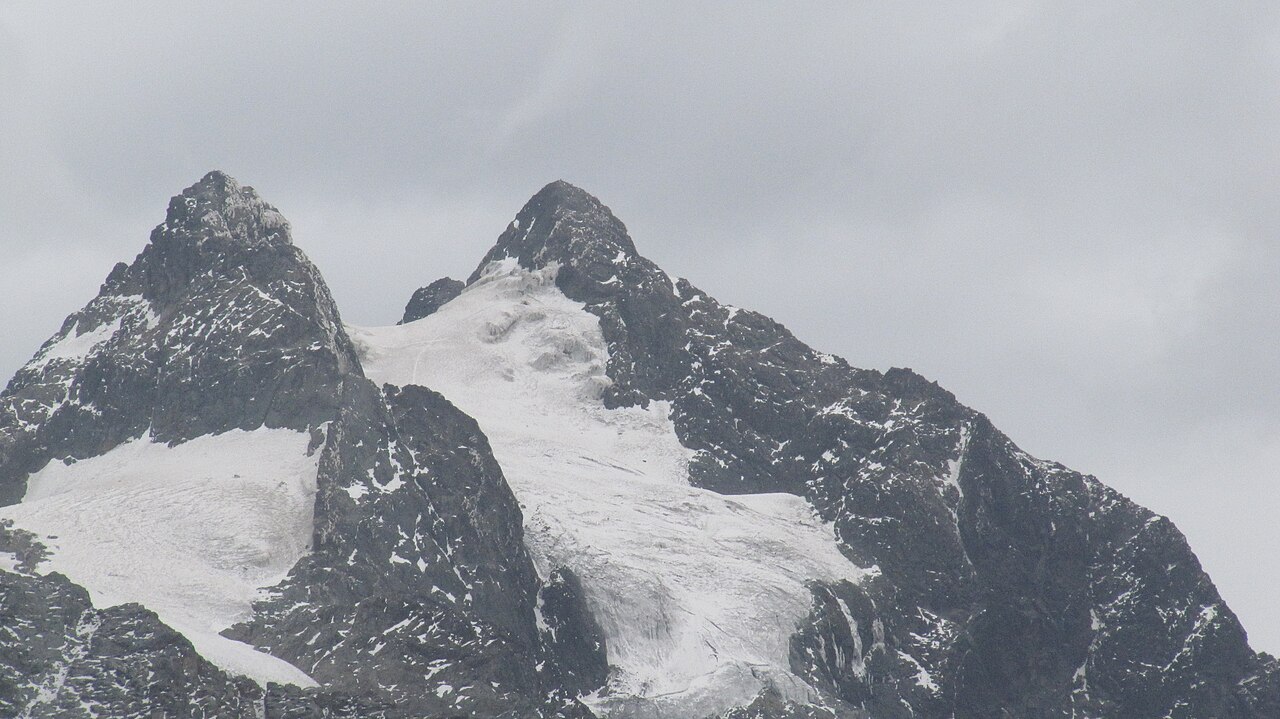
A Summit of Continental Rank
At 5,109 metres, Margherita Peak is the third-highest point in Africa, after Kilimanjaro and Mount Kenya. It is the culminating summit of Mount Stanley, the highest massif within the Rwenzori chain — a range of multiple peaks rather than a single mountain. Uganda's Rwenzori Mountains National Park, a UNESCO World Heritage Site protecting the range's eastern flank, is contiguous with Virunga National Park on the Congolese side.
Ice at the Equator
The Rwenzori carries permanent glaciers within a few degrees of the equator, sustained by the range's exceptional elevation and the moisture-laden air that moves in from the Congo Basin. The glaciated zone sits above steep valleys, rivers, waterfalls, and mountain lakes, and the range's drainage feeds into the Nile catchment.
Below the glaciers, a sequence of vegetation belts rises through the upper slopes. Heath and afro-alpine moorland dominate at high altitude, home to the giant forms of plant genera found across equatorial East Africa's high mountains — giant heathers, giant groundsels, and giant lobelias. These oversized forms of ordinarily modest plants give the Rwenzori's upper zones a visual character unlike almost any other mountain environment.
The 1906 Duke of Abruzzi Expedition
The first documented ascent of Margherita Peak was made in 1906 by an expedition led by Luigi Amedeo di Savoia, the Duke of Abruzzi — an Italian royal and experienced mountaineer who had already completed high-altitude and polar expeditions before the Rwenzori. The expedition named the summit Margherita Peak in honour of the Italian royal house and produced the first systematic mountaineering record for the Stanley massif, placing the Rwenzori within serious alpinism at a time when much of equatorial Africa's mountain geography remained incompletely surveyed.
In 2016, Italian military mountaineers made a commemorative ascent of Margherita Peak to mark the 110th anniversary of the Duke of Abruzzi's climb. The event was recorded by the Italian Embassy in Kampala and noted by the Mountain Club of Uganda, which has maintained its own historical connection to the range.